A good escape room puzzle design combines logical challenges, engaging teamwork, clear clues, and an immersive story. The best puzzles are fair, rewarding, and progressively more difficult while encouraging observation, communication, and critical thinking. Great designs create memorable “aha!” moments instead of relying on random guessing.
What Makes a Good Escape Room Puzzle Design – Escape rooms are more than locked boxes and hidden keys. The best ones tell a story, encourage teamwork, and create memorable moments that players talk about long after the game ends. Behind every successful escape room is thoughtful puzzle design that balances challenge, fairness, creativity, and excitement.
If you’ve ever wondered why some escape rooms feel incredibly satisfying while others become frustrating, the answer usually lies in the quality of the puzzles rather than the room itself. Great puzzle design keeps players engaged from the opening clue to the final escape without making them feel confused or overwhelmed.
Whether you’re designing your first escape room, improving an existing game, or simply curious about how these experiences are built, understanding the principles of effective puzzle design is the first step. This guide explains what separates average puzzles from exceptional ones while offering practical advice that beginners can immediately apply.
By the end, you’ll understand not only what makes a good escape room puzzle design but also why certain techniques consistently produce enjoyable experiences for players of different skill levels.
Why Puzzle Design Matters More Than Decorations
Many first-time designers invest most of their budget in impressive props, lighting, and themed decorations. While immersive environments certainly enhance an escape room, they cannot compensate for weak puzzle design.
Players remember how a room made them feel. If puzzles are confusing, repetitive, or unfair, even a beautiful environment loses its appeal. On the other hand, a room with modest decorations but excellent puzzles often earns enthusiastic recommendations.
Professional escape room designers usually focus on four goals:
- Keep players actively participating.
- Reward logical thinking instead of random guessing.
- Maintain a steady sense of progress.
- Deliver memorable “aha!” moments.
Practical takeaway: Before purchasing expensive props, spend time refining your puzzle flow. Strong gameplay creates lasting memories.
A Simple Definition of Good Escape Room Puzzle Design
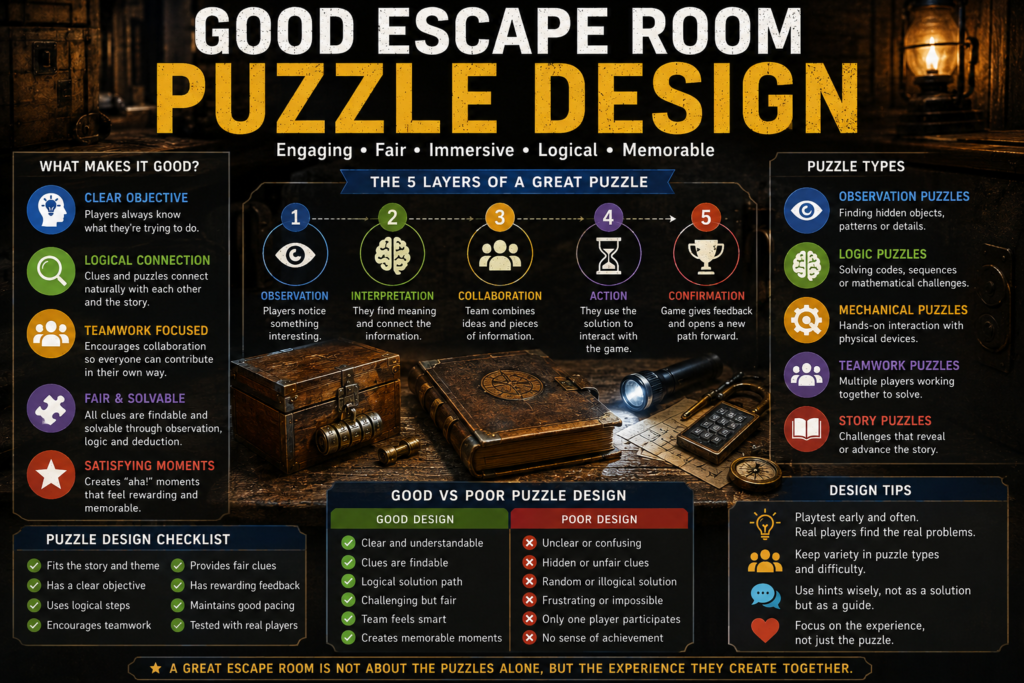
A good escape room puzzle design is a carefully planned sequence of interconnected challenges that players can solve through observation, reasoning, communication, and teamwork while staying engaged with the room’s story and objectives.
This definition includes several important characteristics.
A quality puzzle should be:
- Fair rather than misleading.
- Challenging without becoming impossible.
- Logical enough that clues make sense afterward.
- Connected to the room’s theme.
- Enjoyable for groups with different experience levels.
The objective is not to make players feel unintelligent. Instead, it is to help them experience the satisfaction of solving increasingly meaningful challenges.
The PACE Framework for Designing Better Escape Room Puzzles
Many guides discuss puzzle difficulty, but fewer explain how successful designers evaluate an entire experience. A practical way to approach this is through the PACE Framework.
P — Purpose
Every puzzle should have a reason to exist.
Ask yourself:
- Does it advance the story?
- Does it unlock new information?
- Does it reveal another area?
- Does it encourage teamwork?
If removing the puzzle would not affect the overall experience, it probably doesn’t belong.
A — Accessibility
Players should understand what they are trying to accomplish, even if they don’t immediately know how to solve it.
Good accessibility means:
- Clear objectives.
- Visible clues.
- Readable instructions.
- Fair feedback.
C — Connection
Every puzzle should naturally connect with previous discoveries.
Instead of feeling isolated, puzzles should build upon one another like chapters in a mystery novel.
E — Engagement
A puzzle should involve multiple players whenever possible.
Avoid situations where one participant solves everything while others simply watch.
Practical takeaway: Review every puzzle using the PACE Framework before adding it to your room. It helps identify unnecessary complexity and improves the overall player experience.
The Psychology Behind Satisfying Puzzle Experiences
The most enjoyable escape room puzzles are designed around human psychology rather than pure difficulty.
Players enjoy solving problems because each success creates a sense of achievement. However, that feeling disappears when puzzles become unpredictable or rely entirely on guessing.
Successful puzzle design often follows this emotional journey:
Curiosity leads players to explore the room.
Discovery gives them useful information.
Experimentation allows them to test ideas.
Breakthrough creates excitement.
Progress motivates them to continue.
Final success delivers a memorable conclusion.
When this cycle repeats naturally throughout the game, players remain engaged even if they occasionally struggle.
Practical takeaway: Design for emotional progression, not just puzzle progression.
Comparing Good and Poor Puzzle Design
| Feature | Effective Puzzle Design | Poor Puzzle Design |
|---|---|---|
| Clarity | Players know the objective | Players are unsure what to do |
| Difficulty | Challenging but fair | Confusing or impossible |
| Story Integration | Supports the narrative | Feels disconnected |
| Teamwork | Encourages collaboration | One person dominates |
| Feedback | Players know when they’re making progress | No indication of success |
| Logic | Solutions feel satisfying | Solutions feel random |
The difference often comes down to thoughtful planning rather than expensive technology.
Practical takeaway: If testers repeatedly become confused in the same place, the issue is usually the puzzle—not the players.
The Five Layers of an Outstanding Escape Room Puzzle
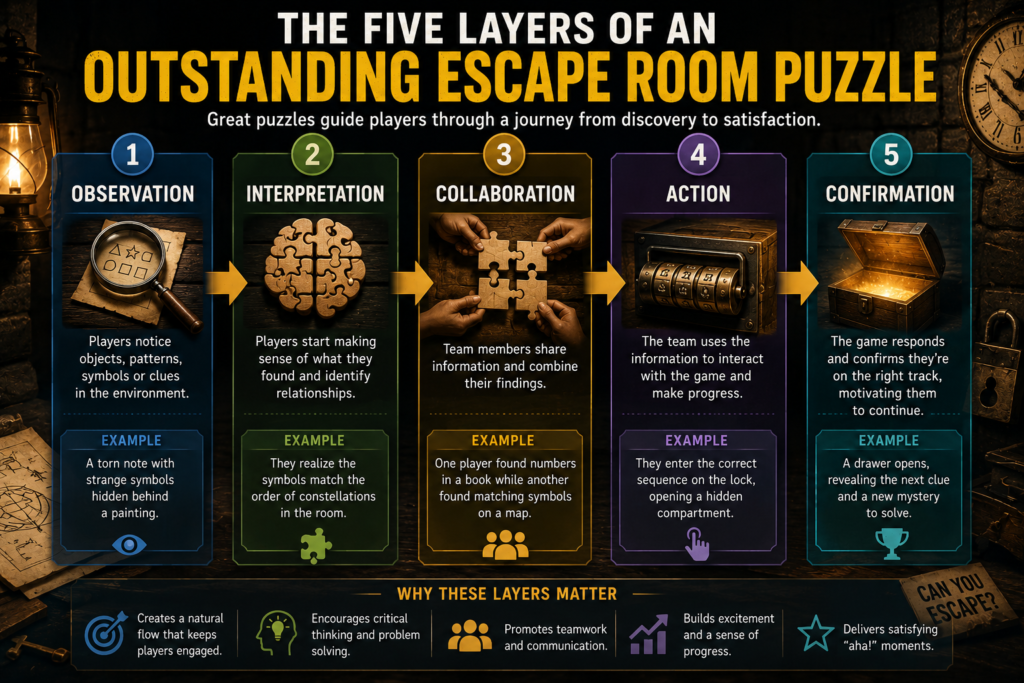
Rather than viewing puzzles as single tasks, experienced designers build multiple layers that gradually reveal the solution.
Layer 1: Observation
Players notice unusual objects, patterns, or symbols.
Examples include:
- Hidden markings.
- Color arrangements.
- Maps.
- Decorative items with meaning.
Layer 2: Interpretation
Players begin understanding why those observations matter.
They identify relationships, organize information, or discover patterns.
Layer 3: Collaboration
Different team members combine their findings.
One player may discover numbers while another uncovers matching symbols elsewhere in the room.
Layer 4: Action
The team uses the collected information to interact with the room.
This might involve opening a lock, arranging objects, activating a mechanism, or revealing another clue.
Layer 5: Confirmation
The room provides immediate feedback.
Examples include:
- A drawer opens.
- A hidden compartment slides out.
- Lights activate.
- Music changes.
- Another puzzle becomes available.
Practical takeaway: Great puzzles reward players at every stage instead of only at the final solution.
Original Comparison Table: Puzzle Types and Their Best Uses
| Puzzle Type | Best For | Teamwork Level | Replay Value | Common Design Risk |
|---|---|---|---|---|
| Logic Puzzle | Analytical groups | Medium | High | Too complex |
| Observation Puzzle | Beginners | High | Medium | Hidden clues become unfair |
| Pattern Recognition | Mixed experience teams | High | High | Repetitive designs |
| Mechanical Puzzle | Hands-on players | Very High | High | Equipment failures |
| Story-Based Puzzle | Immersive experiences | Medium | Medium | Weak narrative connection |
| Communication Puzzle | Large groups | Excellent | High | One-way participation |
Choosing the right mix creates a more balanced room than relying on a single puzzle style.
Designing for Teams Instead of Individuals
Escape rooms are social experiences.
One of the biggest mistakes new designers make is creating puzzles that only one person can solve while everyone else waits.
Instead, design moments where different players contribute unique pieces of information.
Imagine one player discovers a coded journal while another uncovers a strange machine in another corner of the room. Neither clue is useful alone, but together they reveal the next step.
This approach naturally encourages discussion, cooperation, and shared success.
Professional designers often ask a simple question during testing:
“Is everyone participating?”
If the answer is no, the puzzle usually needs redesigning.
Practical takeaway: Every major puzzle should create opportunities for multiple players to contribute.
Successful escape rooms encourage every participant to contribute instead of allowing one person to solve every challenge. Collaborative problem-solving has long been recognized as an effective way to improve communication, decision-making, and teamwork. Resources from the Association for Talent Development explain why shared learning experiences often produce stronger team performance.
Decision Checklist: Is Your Puzzle Ready?
Before introducing a puzzle into an escape room, review this checklist:
- Does the puzzle fit the room’s story?
- Is the objective obvious even if the solution isn’t?
- Can players solve it without outside knowledge?
- Does it reward observation and logic instead of guessing?
- Can more than one player participate?
- Is there clear feedback when progress is made?
- Have multiple test groups solved it successfully?
- Are clues visible without being overly obvious?
- Does solving it unlock meaningful progress?
- Would players describe the solution as fair after finishing?
If several answers are “no,” refine the design before launch.
Mini Case Study: Turning a Frustrating Puzzle into a Favorite
A designer created a museum-themed escape room where players had to identify the correct painting to reveal a hidden safe. During testing, nearly every group became stuck because the only clue was a tiny symbol hidden behind a decorative frame.
Instead of making the puzzle easier, the designer redesigned the clue sequence. Players first discovered a curator’s notebook describing missing artwork. Later, they found a restoration lamp that revealed invisible markings on several paintings. Finally, those markings matched information in the notebook, guiding players to the correct artwork.
The puzzle remained challenging, but it became logical and rewarding because every clue built upon the previous one.
The lesson is simple: difficulty should come from thoughtful reasoning, not from hiding essential information.
Balancing Puzzle Difficulty Without Frustrating Players
One of the hardest parts of escape room design is finding the right level of difficulty. If puzzles are too simple, players finish quickly and leave feeling underwhelmed. If they are too difficult, excitement turns into frustration.
A better approach is to create a gradual learning curve. The first few puzzles should build confidence and teach players how the room “thinks.” Later challenges can become more complex because players have already learned the room’s logic.
Think of the experience as climbing a hill instead of a vertical wall.
A balanced escape room usually includes:
- Easy introductory puzzles that everyone can solve.
- Medium puzzles requiring teamwork.
- One or two difficult puzzles near the end.
- A satisfying final challenge that combines earlier discoveries.
Practical takeaway: Difficulty should increase naturally rather than randomly.
The Puzzle Flow Blueprint
Great escape rooms rarely rely on a straight line of puzzles. Instead, they carefully manage how information becomes available.
A useful workflow looks like this:
Explore → Discover → Connect → Solve → Unlock → Explore Again
Each completed puzzle should naturally lead players toward the next objective.
Signs of healthy puzzle flow include:
- Players are always working on something.
- New clues appear regularly.
- Progress feels continuous.
- Nobody spends excessive time waiting.
If players spend ten minutes wondering where to begin, the opening sequence needs improvement.
Practical takeaway: Every solved puzzle should clearly create the next objective.
Linear vs Parallel Puzzle Design
Choosing the right puzzle structure significantly affects player experience.
| Design Style | Best For | Advantages | Challenges |
|---|---|---|---|
| Linear | Beginners | Easy to follow, simple progression | Large groups may wait |
| Parallel | Larger teams | Everyone stays involved | Requires careful coordination |
| Hybrid | Most commercial escape rooms | Balanced teamwork and pacing | More complex to design |
A hybrid approach often provides the best experience.
For example, two smaller puzzles may be solved independently before combining their solutions to unlock the next stage.
This keeps everyone active while maintaining a clear overall direction.
Practical takeaway: Design multiple opportunities for different players to contribute simultaneously.
Story Should Guide Every Puzzle
The strongest escape rooms never separate puzzles from the story.
Imagine entering an abandoned laboratory.
Instead of solving random number locks, players might:
- Restore power to forgotten equipment.
- Decode a scientist’s research journal.
- Repair damaged machinery.
- Stabilize a dangerous experiment.
- Escape before the countdown reaches zero.
Each puzzle feels meaningful because it supports the narrative.
Ask yourself these questions during design:
- Why does this puzzle exist?
- Would it still make sense outside this story?
- Does solving it move the narrative forward?
If the answer is no, reconsider its purpose.
Practical takeaway: Every puzzle should feel like part of the adventure rather than an obstacle.
Designing Clues That Feel Fair
Many designers confuse difficulty with secrecy.
Players should never fail because important information was impossible to notice.
Effective clues often follow three principles.
Reinforce Important Information
Critical clues can appear more than once in different ways.
For example:
- A written journal.
- A wall diagram.
- An audio recording.
Repeating information prevents accidental dead ends.
Reward Observation
Instead of hiding clues behind impossible locations, place them where attentive players can discover them naturally.
Avoid Guesswork
Players should never have to randomly try hundreds of combinations.
If multiple answers seem equally possible, more guidance is needed.
Practical takeaway: Fair clues challenge thinking—not eyesight or luck.
Expert Recommendation
Design every puzzle so that players can explain the solution afterward.
When people finish a great escape room, they often say:
“Of course! That makes perfect sense now.”
They rarely say:
“I would never have figured that out.”
That difference determines whether players leave excited or disappointed.
Common Puzzle Design Mistakes
Even experienced designers occasionally introduce problems that reduce enjoyment.
Making Every Puzzle a Lock
Too many padlocks become repetitive.
Mix in:
- Mechanical interactions.
- Hidden compartments.
- Physical challenges.
- Technology.
- Sound effects.
- Light-based reveals.
Requiring Outside Knowledge
Players should not need advanced mathematics, foreign languages, or specialized history unless clearly introduced within the room.
Everything necessary should exist inside the experience.
Overcomplicated Instructions
If explaining the puzzle takes several paragraphs, simplify it.
Good puzzles teach themselves through interaction.
Dead-End Objects
Decorative items should not constantly distract players.
Too many meaningless props create confusion.
Practical takeaway: Every object should either support the story or contribute to gameplay.
Myths vs Facts About Escape Room Puzzle Design
| Myth | Reality |
|---|---|
| Harder puzzles create better rooms. | Fair puzzles create better experiences. |
| More locks make rooms exciting. | Variety keeps players engaged. |
| Confusing players increases challenge. | Clear objectives improve satisfaction. |
| Expensive technology guarantees success. | Creative design matters more than budget. |
| Hidden clues should be nearly impossible to find. | Clues should reward careful observation. |
| Every puzzle must be unique. | Familiar mechanics with creative twists often work better. |
Understanding these misconceptions helps designers avoid common pitfalls.
Building Memorable “Aha!” Moments
The emotional highlight of every escape room is the moment when scattered clues suddenly connect.
These breakthroughs happen when players realize:
- A symbol appears in multiple places.
- Earlier discoveries now have meaning.
- Different teammates hold complementary information.
- An overlooked object becomes important.
Design puzzles that encourage these moments instead of relying solely on difficult calculations.
One effective technique is delayed relevance.
Players discover an object early but only understand its purpose much later.
This creates surprise without feeling unfair.
Practical takeaway: The best puzzles reward memory as much as intelligence.
Testing Is Where Great Rooms Are Made
No escape room should open without extensive playtesting.
Professional designers often learn more from watching players than from designing puzzles.
Observe silently.
Notice:
- Where players hesitate.
- Which clues they ignore.
- Which puzzles create excitement.
- Which moments cause frustration.
- How teams communicate.
Avoid explaining puzzles during testing.
Instead, ask afterward:
- What felt unfair?
- What was your favorite puzzle?
- Where did you become confused?
- Which clue helped the most?
- Would you recommend this room?
Patterns quickly emerge.
If five different groups struggle at the same location, redesign that section.
Practical takeaway: Players rarely fail because they lack intelligence. They usually fail because the design needs refinement.
Implementation Roadmap for First-Time Designers
If you’re creating your first escape room, follow this practical roadmap.
Stage 1: Build the Story
Create a clear setting, objective, and ending.
Stage 2: Identify Major Milestones
Decide what players must accomplish throughout the experience.
Stage 3: Design Core Puzzles
Develop puzzles that naturally support each milestone.
Stage 4: Add Supporting Clues
Ensure every challenge has logical guidance.
Stage 5: Test with Beginners
Observe without interfering.
Stage 6: Simplify
Remove unnecessary complexity.
Stage 7: Test Again
Repeat until players consistently understand the intended experience.
The Future of Escape Room Puzzle Design
Escape rooms continue to evolve as technology and player expectations change.
Several trends are shaping future designs.
Adaptive Difficulty
Some modern rooms adjust puzzle complexity based on player progress, allowing beginners and experienced groups to enjoy the same game.
Interactive Technology
Rather than replacing traditional puzzles, technology now enhances immersion through responsive lighting, projection mapping, RFID objects, and interactive sound systems.
Personalized Storytelling
Designers are creating experiences where player choices influence later puzzles and endings, making each session feel unique.
Sustainable Design
Many escape rooms are reducing disposable materials in favor of reusable props, modular components, and environmentally conscious construction.
AI-Assisted Game Management
Artificial intelligence may soon help game masters monitor player progress, provide context-sensitive hints, and adjust pacing without disrupting immersion.
Practical takeaway: Future innovation should enhance player experience rather than overshadow thoughtful puzzle design.
Quick Summary Table
| Element | Best Practice |
|---|---|
| Difficulty | Gradually increase complexity |
| Story | Every puzzle should support the narrative |
| Teamwork | Encourage simultaneous participation |
| Clues | Clear, logical, and fair |
| Variety | Mix physical, logical, observational, and communication puzzles |
| Testing | Observe real players before launch |
| Technology | Use only when it improves gameplay |
| Success | Create memorable “aha!” moments instead of frustration |
Frequently Asked Questions
How difficult should an escape room puzzle be?
A good puzzle should challenge players while remaining fair. Most groups should solve it through observation, communication, and logical thinking rather than guessing.
How many puzzles should an escape room contain?
There is no universal number. The right amount depends on room length, player experience, and puzzle complexity. Focus on maintaining engagement rather than reaching a specific count.
What type of puzzle is most popular?
Observation, logic, mechanical interaction, and teamwork puzzles consistently perform well because they involve multiple players and fit a wide range of themes.
Can beginners design a successful escape room?
Yes. Starting with a simple story, logical puzzle progression, and thorough playtesting often produces better results than creating overly complex challenges.
How important is technology in modern escape rooms?
Technology can improve immersion, but it should never replace strong puzzle design. Well-crafted traditional puzzles remain enjoyable even without advanced electronics.
Final Thoughts
Understanding what makes a good escape room puzzle design goes far beyond creating clever riddles or hiding keys. Exceptional puzzles combine clear objectives, logical clues, engaging teamwork, and a compelling story that gives every challenge a meaningful purpose. Players remember rooms that reward curiosity, encourage collaboration, and deliver satisfying breakthroughs rather than confusion.
Whether you’re designing a commercial escape room, a classroom activity, or a home game for friends, focus on creating experiences that feel fair, immersive, and rewarding. Build around the player journey, test with real groups, refine based on feedback, and never stop improving. The most successful escape rooms are not defined by the number of locks or the latest technology—they are remembered for the unforgettable moments when every clue suddenly falls into place.