


India has become one of the world’s fastest-growing startup ecosystems. From fintech and healthtech to artificial intelligence and clean energy, thousands of new businesses are launched every year with the ambition of solving real-world problems. Some grow into well-known brands, while many never make it beyond their first few years.
For investors, this creates both opportunity and uncertainty.
Unlike investing in publicly traded stocks, startup investing means backing businesses before they become established. It requires patience, research, and a willingness to accept higher risks in exchange for the possibility of significant long-term returns.
If you are wondering how to invest in startups in India as a beginner, this guide will help you understand the process from the ground up. Rather than focusing only on where to invest, it explains how experienced investors evaluate startups, manage risk, and build diversified portfolios.
By the end of this guide, you will have a practical roadmap for entering India’s startup investment ecosystem with confidence.
Why Startup Investing Is Gaining Popularity in India
India has witnessed rapid digital transformation over the last decade. Increased internet penetration, smartphone adoption, digital payments, and government support for entrepreneurship have encouraged innovation across multiple industries.
As more entrepreneurs build technology-driven companies, investors now have access to opportunities that were once available only to venture capital firms.
Several factors are contributing to this trend:
- Growing number of technology startups
- Increasing participation from angel investors
- Expansion of startup funding platforms
- Government initiatives supporting innovation
- Rising interest among retail investors in alternative assets
The startup ecosystem has evolved beyond major metropolitan cities. Entrepreneurs from smaller cities are now building scalable businesses in education, agriculture, healthcare, logistics, manufacturing, and financial technology.
Practical takeaway: Startup investing is becoming more accessible, but accessibility should never replace proper research.
What Does Investing in a Startup Mean?
Startup investing involves providing capital to a privately owned business in exchange for ownership, usually in the form of equity.
Instead of purchasing shares listed on a stock exchange, investors buy a stake directly from the company during its growth journey.
If the startup succeeds, expands, or is acquired by another company, the value of the investor’s ownership may increase significantly.
However, if the business fails, the investment could lose most or all of its value.
That is why startup investing is often described as a high-risk, high-reward investment strategy.
A Simple Example
Imagine a startup developing AI software for hospitals.
An investor contributes ₹5 lakh for a small ownership stake.
Five years later, the company expands nationally and attracts institutional investors.
The value of the investor’s equity may grow several times over if the business performs well.
On the other hand, if the startup struggles to generate revenue or shuts down, the investment may become worthless.
Practical takeaway: Startup investments should always be viewed as long-term opportunities rather than quick-profit schemes.
Understanding the Startup Growth Journey
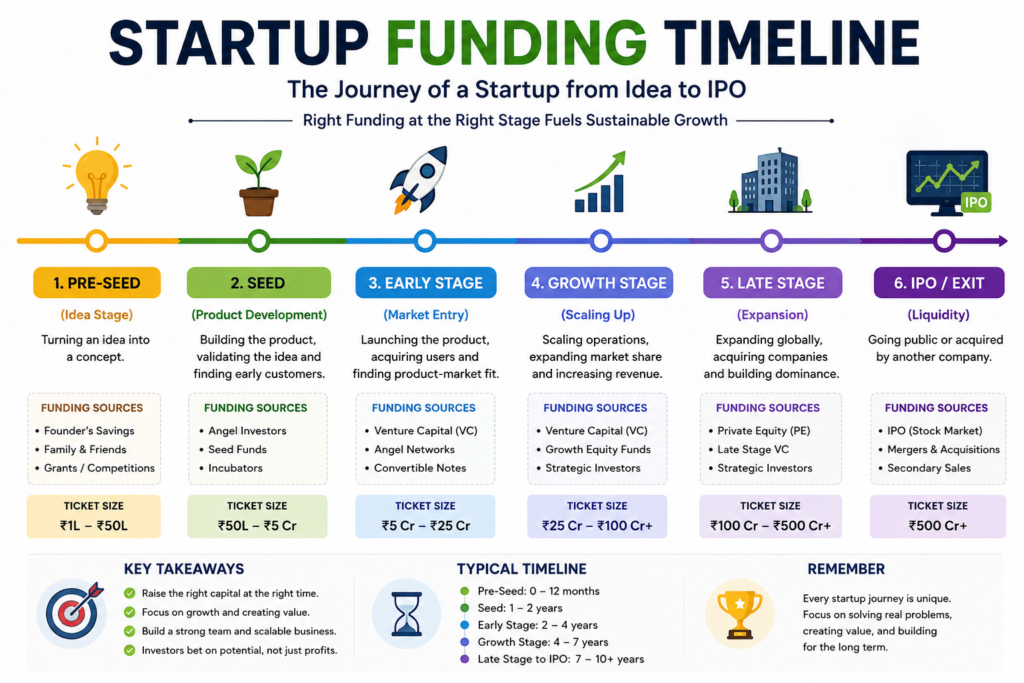
Knowing where a startup stands in its lifecycle helps investors estimate both risk and potential reward.
| Stage | Primary Goal | Investor Risk | Potential Return |
|---|---|---|---|
| Idea | Validate concept | Very High | Very High |
| Pre-Seed | Build initial product | High | High |
| Seed | Acquire first customers | High | High |
| Early Growth | Expand operations | Moderate | Moderate to High |
| Expansion | Scale nationally or globally | Lower | Moderate |
Earlier investments often provide larger ownership opportunities but involve greater uncertainty.
More mature startups generally present lower risk but may also offer comparatively smaller upside.
Practical takeaway: Beginners often benefit from investing in startups that have already demonstrated product-market fit rather than businesses with only an idea.
Is Startup Investing Right for You?
Not every investor should allocate money to startups.
Before making your first investment, ask yourself several important questions.
Can you keep your money invested for many years?
Can you tolerate losing your investment?
Do you already have an emergency fund?
Have you diversified your investment portfolio?
Are you investing only surplus money?
If the answer to most of these questions is yes, startup investing may become a valuable part of your long-term wealth strategy.
Quick Self-Assessment
| Question | Yes | No |
|---|---|---|
| Emergency savings available? | ✔ | |
| Existing diversified investments? | ✔ | |
| Comfortable with long holding periods? | ✔ | |
| Can accept investment losses? | ✔ | |
| Investing surplus capital only? | ✔ |
If several answers fall under “No,” consider strengthening your overall financial foundation before exploring startup investments.
Practical takeaway: Startup investing should complement your financial plan, not replace traditional investments.
Different Ways to Invest in Startups in India
One of the biggest misconceptions is that startup investing is reserved for wealthy venture capitalists.
Today, investors have multiple ways to participate depending on their financial goals and investment capacity.
1. Angel Investing
Angel investors provide capital directly to promising startups during their early stages.
In addition to funding, many angel investors also contribute industry knowledge, mentoring, and business connections.
This approach offers significant upside but requires careful evaluation of founders and business models.
Best suited for:
- Experienced investors
- High-net-worth individuals
- Professionals with industry expertise
2. Startup Investment Platforms
Online investment platforms have simplified startup investing by connecting investors with carefully screened businesses.
These platforms often provide company information, financial details, founder interviews, and investment documents.
For beginners, they can offer a structured entry point into startup investing.
3. Angel Networks
Angel networks bring together multiple investors who collectively evaluate startups and invest alongside one another.
Benefits include:
- Shared due diligence
- Access to experienced investors
- Better deal evaluation
- Collaborative investment decisions
4. Venture Capital Funds
Instead of selecting startups individually, investors may participate indirectly through professionally managed venture capital funds where available and appropriate.
Professional fund managers identify investment opportunities and oversee portfolio management.
Although investors have less control over startup selection, they benefit from experienced management.
5. Alternative Investment Structures
Some investment vehicles provide diversified exposure to private businesses instead of relying on a single startup.
Diversification can help reduce the impact of one unsuccessful investment.
Practical takeaway: Beginners often benefit from learning through professional networks or structured investment platforms before making direct investments.
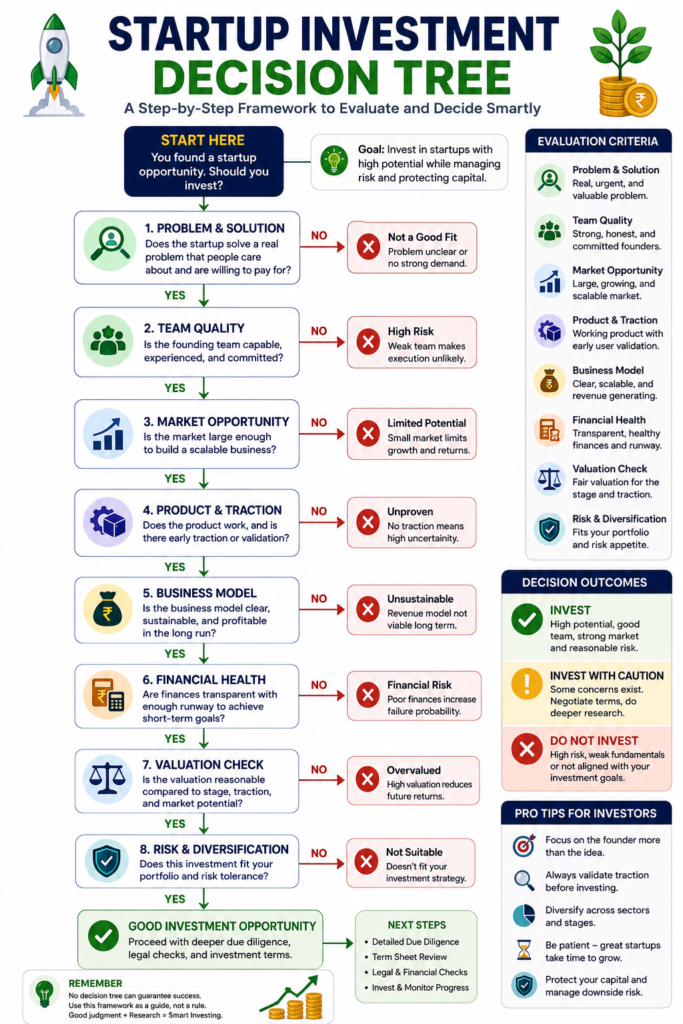
Original Decision Framework: Which Startup Investment Path Fits You?
Instead of choosing based on popularity, match the investment method to your experience and available capital.
| Investor Type | Recommended Approach | Why It Works |
|---|---|---|
| Beginner | Investment Platform | Easier access and structured information |
| Working Professional | Angel Network | Learn from experienced investors |
| Business Owner | Direct Angel Investing | Industry expertise adds value |
| Experienced Investor | Diversified Startup Portfolio | Better long-term risk management |
| Institutional Investor | Venture Capital Fund | Professional portfolio oversight |
This framework helps reduce emotional decision-making by aligning investment methods with investor readiness.
Practical takeaway: The best investment method depends more on your knowledge and objectives than on the amount of money you have.
Industries Attracting Investor Interest
While no sector guarantees success, certain industries continue attracting investor attention because of growing consumer demand and technological innovation.
Some examples include:
Financial Technology
Digital banking, payment solutions, lending technology, insurance innovation, and wealth management platforms continue evolving rapidly.
Artificial Intelligence
Businesses applying AI to healthcare, education, customer service, manufacturing, and enterprise software are expanding across multiple industries.
Healthcare
Technology-driven healthcare solutions, diagnostics, digital consultations, and medical devices continue receiving investor attention.
Education Technology
Online learning platforms, skill development companies, and professional education providers remain important segments.
Climate and Sustainability
Renewable energy, electric mobility, waste management, and environmental technologies are becoming increasingly relevant as sustainability gains importance.
Agriculture Technology
Innovations helping farmers improve productivity, supply chains, irrigation, and crop management continue creating investment opportunities.
Expert Recommendation
Don’t invest simply because a sector is trending. A mediocre startup in a popular industry often underperforms an exceptional startup solving a genuine customer problem. Focus first on the quality of execution, the founding team, and evidence of demand before considering the sector’s popularity.
The First Filter Used by Experienced Investors
One practice that separates experienced investors from beginners is resisting the urge to evaluate financial projections first.
Instead, seasoned investors often begin with a simple question:
“Does this startup solve a meaningful problem that enough people are willing to pay for?”
If the answer is unclear, impressive presentations, large market estimates, or optimistic revenue forecasts become far less convincing.
This “problem-first” mindset helps eliminate many weak opportunities before deeper financial analysis even begins.
Practical takeaway: Before studying valuation or funding rounds, confirm that the startup addresses a real problem, has a clear customer, and offers a solution people genuinely value.
How to Evaluate a Startup Before Investing
A great idea alone is not enough to build a successful company. Many startups with innovative products fail because they struggle with execution, cash flow, leadership, or customer acquisition. Before investing, experienced investors perform structured due diligence to understand whether the business has the potential to grow sustainably.
The Founder Assessment Framework
Early-stage startups often depend more on the founders than the product itself. A capable team can adapt when market conditions change, while a weak team may fail even with a promising idea.
Evaluate founders based on these factors:
- Relevant industry experience
- Problem-solving ability
- Leadership and communication skills
- Transparency with investors
- Long-term commitment
- Ability to attract talented employees
- Willingness to accept feedback
Ask yourself:
- Why are these founders building this company?
- Do they understand the market deeply?
- Have they demonstrated resilience during challenges?
Practical takeaway: Invest in founders who inspire confidence through execution rather than just persuasive presentations.
A Practical Due Diligence Checklist
Before investing, review the startup from multiple perspectives instead of focusing only on projected profits.
Business Model
- Is the product solving a real problem?
- Who are the target customers?
- How does the company generate revenue?
- Is the business scalable?
Market Opportunity
- Is the market expanding?
- How intense is the competition?
- Does the startup have a competitive advantage?
Financial Health
- Current revenue
- Monthly expenses
- Cash runway
- Profit margins
- Funding history
Legal Compliance
Check whether the company has:
- Proper business registration
- Intellectual property protection (if applicable)
- Required licenses
- Shareholding documentation
- Regulatory compliance
Customer Validation
Strong indicators include:
- Paying customers
- Customer retention
- Positive reviews
- Organic referrals
- Repeat purchases
Practical takeaway: Never rely solely on a pitch deck. Verify information through documents, customer feedback, and independent research whenever possible.
Understanding Startup Valuation Without Complex Finance
One of the most confusing aspects of startup investing is valuation.
Simply put, valuation represents what the company is believed to be worth at the time of investment.
Unlike listed companies, startup valuations are often based on growth potential rather than current profits.
Factors Influencing Valuation
- Size of the addressable market
- Revenue growth
- Product uniqueness
- Customer traction
- Team quality
- Competitive positioning
- Previous funding rounds
A higher valuation is not always better for investors. Paying too much for a promising company can reduce future returns.
Comparison Table: High vs. Reasonable Valuation
| Factor | High Valuation | Reasonable Valuation |
|---|---|---|
| Entry Cost | Expensive | More affordable |
| Ownership Percentage | Lower | Higher |
| Return Potential | May be limited | Better upside |
| Investment Risk | Can increase | Often more balanced |
| Future Funding | Needs stronger growth | Greater flexibility |
Practical takeaway: Focus on whether the price reflects realistic growth expectations rather than chasing popular startups.
An Original Startup Scoring Matrix
Instead of making emotional decisions, create a simple scoring system.
| Evaluation Area | Score (1–10) |
|---|---|
| Founder Quality | |
| Product Innovation | |
| Market Size | |
| Customer Demand | |
| Revenue Model | |
| Competitive Advantage | |
| Financial Stability | |
| Scalability | |
| Legal Readiness | |
| Exit Potential |
How to Interpret the Score
- 85–100: Strong investment candidate.
- 70–84: Worth further due diligence.
- 50–69: Proceed cautiously.
- Below 50: Consider passing on the opportunity.
Practical takeaway: A structured scoring method helps reduce bias and improves consistency across investment decisions.
Managing Risk Through Diversification
One of the biggest mistakes beginners make is investing a large amount in a single startup.
Even experienced venture capital firms expect that not every investment will succeed.
A diversified approach spreads risk across different businesses, industries, and growth stages.
Consider diversification by:
- Industry sectors
- Business models
- Geographic markets
- Investment stages
- Founder backgrounds
Think of startup investing as building a portfolio rather than placing one big bet.
Common Mistakes New Startup Investors Should Avoid
Learning from others’ mistakes can save both money and time.
Investing Because of Hype
Popular industries often attract attention, but excitement alone is not a reliable investment strategy.
Ignoring Due Diligence
Skipping research because a startup has famous investors or media coverage can lead to poor decisions.
Expecting Quick Returns
Startup investments usually take years to mature. Patience is essential.
Investing Money You Cannot Afford to Lose
Startup investing should involve only surplus capital after covering emergency savings and essential financial goals.
Overlooking Founder Quality
A strong product cannot compensate for poor leadership over the long term.
Practical takeaway: Discipline and research are often more valuable than finding the “next unicorn.”
Original Startup Investment Roadmap
Stage 1: Build Financial Readiness
- Create an emergency fund.
- Reduce high-interest debt.
- Diversify traditional investments.
Stage 2: Learn the Ecosystem
- Understand startup funding stages.
- Read founder interviews.
- Follow startup news.
- Attend entrepreneurship events.
Stage 3: Define Your Investment Strategy
Decide:
- Investment budget
- Preferred industries
- Risk tolerance
- Investment timeline
Stage 4: Evaluate Opportunities
Apply your due diligence checklist and scoring matrix before making any commitment.
Stage 5: Monitor Without Micromanaging
Track:
- Revenue growth
- Customer acquisition
- Product development
- Funding announcements
- Founder communication
Practical takeaway: Treat startup investing as a long-term learning journey rather than a one-time transaction.
Myths vs. Facts
| Myth | Reality |
|---|---|
| Startup investing is only for millionaires. | More investment options are becoming accessible, though eligibility requirements may apply depending on the platform or investment structure. |
| Every startup can become the next unicorn. | Most startups face significant challenges, and many do not achieve large-scale success. |
| A great product guarantees success. | Execution, leadership, funding, and customer adoption matter just as much. |
| You will make profits quickly. | Startup investments often require patience over several years. |
| Media attention equals investment quality. | Publicity does not replace careful due diligence. |
The Future of Startup Investing in India
India’s entrepreneurial ecosystem continues to evolve rapidly. Several trends are expected to shape the next generation of startup investments.
Emerging areas include:
- Artificial intelligence applications
- Climate technology
- Deep technology
- Space technology
- Healthcare innovation
- Financial inclusion
- Rural technology solutions
- Manufacturing innovation
- Robotics and automation
- Digital infrastructure
Government initiatives supporting innovation, expanding digital adoption, and increasing investor participation may continue creating opportunities for entrepreneurs and investors alike. However, market conditions, regulations, and funding cycles can change, making continuous learning essential.
Practical takeaway: Future opportunities will likely favor startups solving meaningful, scalable problems with sustainable business models rather than businesses built around short-term trends.
Frequently Asked Questions
Can beginners invest in startups in India?
Yes. Beginners can start by learning about startup investing, exploring regulated investment avenues where available, and investing only after completing proper research and understanding the risks.
How much money should I invest?
There is no universal amount. Invest only money you can afford to keep locked in for several years and potentially lose without affecting your financial security.
Are startup investments risky?
Yes. Startup investing carries higher risk than many traditional investments because early-stage businesses may fail despite having promising ideas.
How long should I hold a startup investment?
Startup investments are generally long-term. Investors should be prepared for holding periods that may extend over several years before a liquidity event occurs.
How do startup investors earn returns?
Returns may come if the startup is acquired, goes public, or offers another exit opportunity that increases the value of the investor’s ownership stake.
{ “@context”:”https://schema.org”, “@type”:”FAQPage”, “mainEntity”:[ { “@type”:”Question”, “name”:”Can beginners invest in startups in India?”, “acceptedAnswer”:{ “@type”:”Answer”, “text”:”Yes. Beginners can invest after understanding startup investing, researching opportunities, and investing only surplus capital.” } }, { “@type”:”Question”, “name”:”Are startup investments risky?”, “acceptedAnswer”:{ “@type”:”Answer”, “text”:”Yes. Startup investing carries significant risk because early-stage businesses can fail. Diversification and due diligence help reduce risk.” } }, { “@type”:”Question”, “name”:”How do startup investors make money?”, “acceptedAnswer”:{ “@type”:”Answer”, “text”:”Investors earn returns when startups grow in value and achieve exits such as acquisitions, mergers, or public listings.” } } ] }Final Thoughts
Investing in startups in India offers the opportunity to support innovation while participating in the growth of emerging businesses. It is an exciting asset class, but it demands patience, disciplined research, and realistic expectations.
Successful startup investing is rarely about finding the perfect company on the first attempt. It is about consistently applying sound evaluation methods, diversifying your investments, understanding the founders behind the business, and focusing on long-term value creation.
If you are just beginning, start small, continue learning, and rely on evidence instead of excitement. Over time, experience becomes one of your greatest investment advantages.
By following a structured approach, respecting the risks, and making informed decisions, you can build a startup investment strategy that aligns with your financial goals while contributing to India’s growing innovation economy.