Choosing a career in healthcare does not always require becoming a doctor or a registered nurse. Across Bihar, many students are exploring short-term healthcare training programs that help them build practical skills and enter the medical support sector. One course that often attracts attention is the CMS ED course in Bihar.
If you have searched online, you may have noticed conflicting information about this course. Some sources describe it as a pathway to healthcare employment, while others make unrealistic claims about medical practice. This makes it difficult for beginners to understand what the course actually offers.
This guide is designed to provide a balanced, practical explanation. Rather than focusing only on promotional information, it explains the course, its typical curriculum, admission process, fee structure, career possibilities, limitations, and the important questions every student should ask before enrolling.
Whether you are a recent school graduate, someone looking for a healthcare-related career, or a parent researching options for your child, this article will help you make a more informed decision.
What Is a CMS ED Course?
The CMS ED course generally refers to a healthcare training program intended to introduce students to basic medical knowledge, emergency response techniques, first aid, patient care, health awareness, and community healthcare practices.
The exact meaning of “CMS ED” may differ between institutions because there is no single nationally standardized curriculum under this name. For this reason, prospective students should carefully review the syllabus, recognition, certification, and training facilities before enrolling.
Unlike professional degrees such as MBBS, BDS, or B.Sc. Nursing, a CMS ED course is typically designed as a vocational or skill-development program that emphasizes practical healthcare support rather than advanced clinical practice.
Practical takeaway: Always verify what a particular institute includes in its CMS ED curriculum instead of assuming that every course follows the same format.
Why Students in Bihar Choose CMS ED Courses
Healthcare services are expanding in both urban and rural parts of Bihar. Alongside hospitals, diagnostic centers, clinics, rehabilitation facilities, and community health organizations, there is increasing demand for trained support staff who understand basic healthcare procedures.
Students often choose the course because it offers:
- A comparatively shorter study duration than many degree programs.
- Lower educational barriers for beginners.
- Exposure to healthcare environments.
- Practical learning opportunities.
- An affordable starting point for healthcare careers.
For many learners, the course also serves as a stepping stone before pursuing more advanced qualifications in nursing, paramedical sciences, public health, or healthcare management.
Practical takeaway: Think of the course as an entry point into healthcare learning rather than a shortcut to becoming a licensed medical practitioner.
Who Should Consider This Course?
Not every healthcare course is suitable for every student. Before applying, ask yourself why you want to join.
This course may be suitable if you:
- Enjoy helping people.
- Remain calm during emergencies.
- Want practical healthcare exposure.
- Prefer skill-based learning.
- Plan to work in community health settings.
- Hope to build experience before pursuing higher education.
It may not be the right choice if your primary goal is immediate eligibility for independent medical practice or specialist clinical work.
Eligibility Criteria for CMS ED Course in Bihar
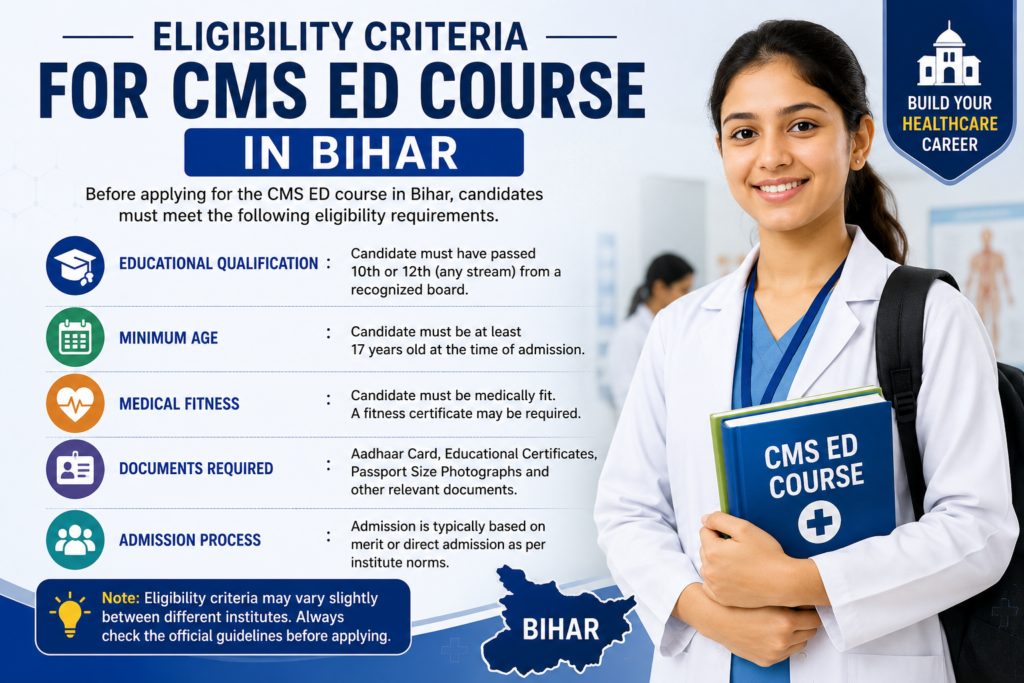
Eligibility requirements vary among institutes, but many training centers commonly expect applicants to meet conditions similar to these.
| Requirement | Typical Expectation |
|---|---|
| Educational qualification | Class 10 or Class 12 (varies) |
| Minimum age | Generally 17 years or above |
| Medical fitness | May be required |
| Identity documents | Aadhaar, photographs, educational certificates |
| Admission process | Application and document verification |
Some institutes may conduct interviews or counseling sessions before confirming admission.
Practical takeaway: Never rely on advertisements alone. Request written admission guidelines before paying any registration fee.
Understanding the Learning Journey
Instead of viewing the course as a collection of subjects, imagine it as a sequence of practical healthcare skills.
Stage 1: Healthcare Foundations
Students are introduced to:
- Human anatomy basics
- Body systems
- Common illnesses
- Hygiene principles
- Medical terminology
This foundation helps students understand how healthcare professionals communicate and work.
Stage 2: Patient Care Skills
Training often includes:
- Measuring temperature
- Pulse recording
- Blood pressure observation
- Patient comfort
- Infection prevention
- Basic nursing assistance
Stage 3: Emergency Response
Emergency care is one of the most valuable components.
Students may learn:
- First aid
- CPR awareness
- Wound management
- Fracture support
- Bleeding control
- Emergency transportation basics
Stage 4: Community Healthcare
Many institutes introduce topics such as:
- Public health awareness
- Nutrition education
- Vaccination awareness
- Maternal health
- Child health
- Rural healthcare challenges
Stage 5: Practical Training
Clinical exposure, demonstrations, laboratory sessions, or observational hospital visits may be included depending on the institute.
Practical takeaway: The more practical exposure an institute provides, the more valuable the learning experience is likely to be.
Original Decision Framework: Is This the Right Course for You?
Before enrolling, score yourself honestly.
| Question | Yes | No |
|---|---|---|
| Do you enjoy helping sick people? | □ | □ |
| Can you stay calm under pressure? | □ | □ |
| Are you willing to continue learning after this course? | □ | □ |
| Do you prefer practical work over desk jobs? | □ | □ |
| Are you comfortable working in healthcare settings? | □ | □ |
If you answer “Yes” to most questions, the course may align well with your interests. If not, explore other healthcare or vocational options before making a decision.
What Makes One Institute Better Than Another?
Many students compare only course fees. Experienced education counselors often recommend evaluating several factors together.
Institute Evaluation Matrix
| Factor | Why It Matters |
|---|---|
| Experienced faculty | Better practical instruction |
| Updated syllabus | More relevant skills |
| Practical laboratories | Hands-on learning |
| Clinical exposure | Real-world understanding |
| Student support | Better learning experience |
| Placement guidance | Career assistance |
| Transparent fee structure | Avoids hidden charges |
An institute with excellent practical facilities may provide greater long-term value than one offering the lowest fees.
Practical takeaway: Compare learning quality—not just affordability.
Common Subjects You May Study
Although syllabi differ, many CMS ED programs include subjects similar to:
- Human anatomy
- Physiology
- Basic pathology
- Pharmacology awareness
- Community medicine
- Medical ethics
- Emergency care
- First aid
- Patient communication
- Nutrition basics
- Infection control
- Health education
Some institutes also include computer skills and healthcare documentation.
Real-World Example
Imagine two students, Rohan and Neha.
Rohan joins an institute simply because it advertises the lowest fees. Practical sessions are limited, and students rarely interact with healthcare professionals.
Neha spends extra time comparing institutes. She selects one with experienced instructors, practical demonstrations, hospital exposure, and career counseling.
After completing the course, Neha feels more confident during interviews because she has observed real healthcare environments and practiced essential skills.
The lesson is simple: quality training often matters more than choosing the cheapest option.
Skills That Employers Appreciate
Employers increasingly value workplace readiness alongside technical knowledge.
Important skills include:
- Communication
- Empathy
- Observation
- Teamwork
- Time management
- Patient confidentiality
- Professional behavior
- Record keeping
- Problem solving
- Basic computer literacy
Developing these skills during training can improve employability regardless of the specific healthcare role you pursue.
Questions Every Student Should Ask Before Admission
Many admission mistakes happen because students hesitate to ask important questions.
Consider asking:
- Is the curriculum available in writing?
- How many practical sessions are included?
- Are there laboratory facilities?
- Is internship or hospital exposure offered?
- What certification will I receive?
- What additional expenses should I expect?
- Is placement support available?
- Can former students share their experiences?
These questions often reveal more about an institute than promotional brochures.
Expert Recommendation
Never choose a CMS ED course based only on social media advertisements or promises of guaranteed employment. Instead, visit the institute, inspect classrooms and practical facilities, meet faculty members, request detailed course information, and understand the scope of the certification before enrolling. An informed decision today can prevent disappointment later.
Common Misconceptions
Several myths continue to circulate among students.
Myth: Every CMS ED certificate allows independent medical practice.
Fact: Course recognition, legal scope, and professional responsibilities vary. Always understand the applicable regulations before assuming any professional authority.
Myth: The shortest course is always the best option.
Fact: Practical training and skill development are generally more valuable than course duration alone.
Myth: Low fees automatically mean good value.
Fact: Hidden charges, poor facilities, and limited practical exposure can reduce the overall quality of education.
Myth: Classroom learning is enough.
Fact: Healthcare careers depend heavily on practical competence, communication, and supervised experience.
Preparing Yourself Before Joining
Students who prepare early often perform better throughout the program.
A few useful habits include:
- Improving English and Hindi medical vocabulary.
- Learning basic computer operations.
- Practicing effective communication.
- Reading about healthcare ethics.
- Developing disciplined study routines.
- Staying physically and mentally fit.
- Building confidence in interacting with patients.
These habits can make the transition into healthcare training much smoother.
Key Takeaways
A CMS ED course in Bihar can be a useful starting point for individuals interested in healthcare support and community medical services. However, choosing the right institute requires careful research. Instead of focusing only on advertisements or fee discounts, evaluate the curriculum, practical exposure, faculty experience, infrastructure, and career guidance.
Most importantly, approach the course with realistic expectations. The strongest career outcomes usually come from combining quality training, continuous learning, professional ethics, and hands-on experience. Students who invest time in developing both technical knowledge and interpersonal skills are generally better prepared for future opportunities in the healthcare sector.
CMS ED Course Fees in Bihar: What Should You Expect?
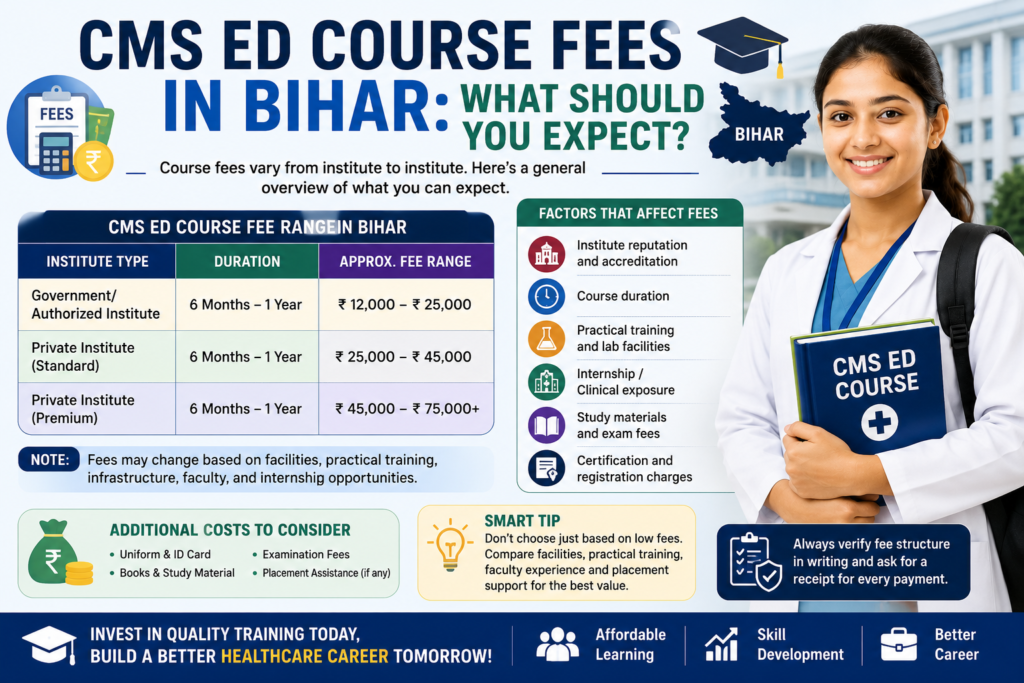
One of the most searched questions is about CMS ED course fees in Bihar. While many institutes advertise attractive prices, the actual cost can vary depending on factors such as the training provider, course duration, facilities, practical sessions, study materials, and internship opportunities.
Instead of choosing the lowest fee, consider the overall value of the program.
Factors That Influence Course Fees
The total fee may depend on:
- Institute reputation
- Duration of the course
- Practical laboratory training
- Clinical or hospital exposure
- Examination fees
- Registration charges
- Study materials
- Certification costs
- Placement assistance
Some institutes allow installment payments, making the course more affordable for students from different financial backgrounds.
Practical Takeaway: Ask for a written fee breakdown before paying. This helps you avoid unexpected charges later.
Comparing Low-Cost and Premium Training Institutes
| Feature | Budget Institute | Quality-Focused Institute |
|---|---|---|
| Course Fee | Lower | Moderate to Higher |
| Practical Sessions | Limited | Extensive |
| Faculty Experience | May Vary | Usually Experienced |
| Infrastructure | Basic | Better Equipped |
| Student Support | Limited | Comprehensive |
| Placement Guidance | Sometimes Available | Often Available |
| Overall Learning Experience | Basic | More Practical |
Practical Takeaway: Paying slightly more for better training can provide stronger long-term career benefits.
Can You Get Financial Assistance?
Some private institutes may offer:
- Early admission discounts
- Installment payment options
- Merit-based concessions
- Scholarships (where applicable)
- Special seasonal offers
Always verify such claims directly with the institute.
Career Opportunities After Completing a CMS ED Course
Although career opportunities depend on your training quality, experience, and local regulations, graduates may explore healthcare support roles in different settings.
Potential workplaces include:
- Private clinics
- Diagnostic laboratories
- Community health centers
- Nursing homes
- NGOs working in healthcare
- Rural health projects
- Medical camps
- Health awareness organizations
- Wellness centers
Some students also continue their education by enrolling in advanced healthcare or paramedical courses.
Practical Takeaway: Treat your first job as a learning opportunity. Practical experience often matters more than the initial salary.
Skills That Increase Employability
Completing the course alone is rarely enough. Employers also value transferable skills.
Focus on improving:
- Professional communication
- Patient handling
- Computer literacy
- Medical documentation
- Team collaboration
- Time management
- Ethical decision-making
- Observation skills
- Basic English communication
- Problem-solving
Students who continuously upgrade these skills often perform better during interviews and at work.
Career Growth Roadmap
Rather than seeing the CMS ED course as the final destination, think of it as the beginning of your healthcare journey.
Stage 1
Complete the CMS ED course.
Stage 2
Gain practical experience through internships or entry-level healthcare roles.
Stage 3
Develop communication and digital healthcare skills.
Stage 4
Pursue additional certifications in areas such as:
- First Aid
- Emergency Care
- Patient Care
- Healthcare Management
- Medical Documentation
- Public Health
Stage 5
Advance into supervisory, administrative, or specialized healthcare support positions based on your experience and further education.
Implementation Roadmap
| Timeline | Goal |
|---|---|
| Month 1 | Research institutes and compare facilities |
| Month 2 | Complete admission process |
| Months 3–12 | Attend theory and practical classes consistently |
| During Training | Build communication and computer skills |
| Course Completion | Prepare a professional resume |
| First 6 Months of Employment | Gain practical healthcare experience |
| Long-Term | Continue learning through advanced certifications |
Common Mistakes Students Should Avoid
Many students make decisions that affect their future opportunities.
Avoid these mistakes:
- Choosing an institute only because of low fees.
- Believing unrealistic job guarantees.
- Ignoring practical training facilities.
- Not checking faculty qualifications.
- Paying the entire fee without receiving official receipts.
- Assuming every certificate has the same recognition.
- Skipping internship opportunities.
- Neglecting communication skills.
Practical Takeaway: A careful decision today can save both time and money later.
Myths vs Facts
| Myth | Reality |
|---|---|
| The course guarantees a high-paying job. | Employment depends on skills, experience, and employer requirements. |
| All CMS ED courses are identical. | Curriculum and quality vary among institutes. |
| Practical training is optional. | Practical exposure is one of the most valuable parts of healthcare education. |
| Only academic marks matter. | Employers also value communication, professionalism, and teamwork. |
| Learning stops after certification. | Continuous learning is essential in healthcare careers. |
How to Choose the Right Institute in Bihar
Use this checklist before making your final decision.
Decision Checklist
✔ Visit the campus personally.
✔ Verify the course curriculum.
✔ Check practical laboratory facilities.
✔ Meet faculty members if possible.
✔ Ask about internships.
✔ Request a written fee structure.
✔ Verify the certificate offered.
✔ Speak with former students.
✔ Compare multiple institutes.
✔ Read admission terms carefully.
If you can confidently check most of these points, you are likely making a more informed choice.
Future Trends in Healthcare Training
Healthcare education is changing rapidly. Students joining today should prepare for tomorrow’s workplace rather than yesterday’s.
Emerging trends include:
- Digital health records
- Telemedicine support
- Artificial intelligence in healthcare
- Remote patient monitoring
- Infection control specialization
- Elderly care services
- Community health awareness programs
- Basic healthcare technology training
Students who remain adaptable will have better opportunities as healthcare continues to evolve.
Expert Recommendations for Beginners
Choose a course that emphasizes practical learning rather than only classroom teaching. Build strong communication skills, remain committed to ethical healthcare practices, and continue upgrading your knowledge after completing the course. Long-term success comes from continuous improvement rather than relying on a single certification.
Frequently Asked Questions
Is the CMS ED course suitable for beginners?
Yes. Many institutes design the course for students who are starting their healthcare education journey, although eligibility requirements may vary.
What is the duration of a CMS ED course in Bihar?
The duration differs between institutes. Always confirm the official course timeline before admission.
What are the CMS ED course fees in Bihar?
Fees vary depending on the institute, facilities, practical training, and additional services. Request a detailed written fee structure directly from the training provider.
Can I pursue higher education after completing the course?
Many students continue with additional healthcare, nursing, paramedical, or public health programs to expand their career opportunities.
Does practical training matter?
Absolutely. Practical exposure helps students develop confidence, improve patient-care skills, and better understand real healthcare environments.
How can I improve my chances of getting a job?
Focus on practical skills, communication, professionalism, internships, computer literacy, and lifelong learning.
Final Thoughts
A CMS ED course in Bihar can be a valuable option for students who want to begin a career in the healthcare support sector. However, success depends far more on choosing a quality institute, participating actively in practical training, and continuously improving your skills than on the certificate alone.
Before enrolling, compare multiple institutes, understand the curriculum, evaluate practical facilities, and ask detailed questions about fees, internships, and student support. Avoid making decisions based solely on advertisements or promotional claims.
Healthcare is a profession built on responsibility, compassion, and lifelong learning. If you approach your education with realistic expectations, a willingness to gain practical experience, and a commitment to professional ethics, the CMS ED course can serve as a strong foundation for future growth in the healthcare field.
Whether your goal is to work in community health, support clinical teams, or continue toward higher healthcare education, making informed choices today will help shape a more rewarding career tomorrow.