Choosing engine oil may seem like a simple maintenance task, but using the wrong viscosity can affect engine performance, fuel efficiency, cold starts, and long-term durability. Many vehicle owners compare 10W30 and 20W40 engine oils because both are widely available and suitable for different driving conditions. However, the best choice depends on far more than the numbers printed on the bottle.
This guide explains the difference between 10W30 and 20W40 engine oil in simple language. Whether you drive a motorcycle, passenger car, SUV, or light commercial vehicle, you’ll learn how viscosity works, when each oil performs best, and how to avoid common mistakes that can shorten engine life.
Instead of relying on myths or recommendations from friends, you’ll have a practical framework for selecting the right oil based on your vehicle, climate, driving style, and engine condition.
Understanding What the Numbers on Engine Oil Mean
Many people assume that a higher number automatically means better protection. In reality, engine oil grades are designed for specific operating conditions.
The Society of Automotive Engineers (SAE) classifies engine oils according to viscosity. Viscosity describes how easily oil flows at different temperatures.
Let’s decode the two grades.
10W30
- 10W represents the oil’s winter performance.
- 30 represents its viscosity after the engine reaches operating temperature.
20W40
- 20W indicates thicker flow during cold starts.
- 40 means the oil remains thicker at normal engine operating temperatures.
The “W” stands for Winter, not Weight.
A lower number before the W means the oil flows more easily when the engine is cold. A higher number after the W means the oil remains thicker when the engine becomes hot.
Practical takeaway: Engine oil numbers describe how the oil behaves in different temperatures—not its quality.
Why Oil Viscosity Matters More Than Most Drivers Think
Engine oil performs several jobs at the same time.
It lubricates moving parts.
It removes heat.
It reduces wear.
It helps keep internal components clean.
It protects against corrosion.
If the oil is too thin for your engine, the protective film between metal parts may become insufficient under high loads.
If the oil is too thick, it may circulate more slowly during cold starts, delaying lubrication when the engine needs it most.
Imagine drinking water through a straw versus drinking honey. Water flows immediately, while honey takes much longer. Engine oil behaves similarly depending on its viscosity.
Finding the correct balance is what keeps an engine healthy for years.
Practical takeaway: The best oil is not the thickest or thinnest—it’s the one your engine was designed to use.
Quick Comparison: 10W30 vs 20W40
| Feature | 10W30 Engine Oil | 20W40 Engine Oil |
|---|---|---|
| Cold start performance | Excellent | Moderate |
| Flow in winter | Faster | Slower |
| High-temperature thickness | Medium | Higher |
| Fuel economy | Generally better | Slightly lower |
| Engine wear in cold weather | Lower | Can increase if climate is very cold |
| Suitable for newer engines | Yes | Sometimes |
| Suitable for older engines | Depending on condition | Often preferred |
| Best climate | Mild to cold | Warm to hot |
The table highlights that neither oil is universally better. Each serves a different purpose.
The Hidden Difference Most Buyers Ignore
Many discussions focus only on viscosity numbers. A more important question is how your engine has aged.
A brand-new engine has tight internal clearances.
An older engine with higher mileage naturally develops slightly larger clearances due to years of wear.
Thicker oils like 20W40 may provide a stronger oil film in engines with noticeable wear. Meanwhile, a modern engine designed with tight tolerances usually performs best with the lighter viscosity recommended by the manufacturer.
Changing viscosity simply because an engine becomes old is not always necessary. The decision should be based on oil consumption, compression, service history, and manufacturer guidance.
Practical takeaway: Engine condition matters just as much as climate when selecting oil viscosity.
An Original Four-Factor Decision Framework
Instead of asking, “Which oil is better?” ask these four questions.
Factor 1: What Does the Owner’s Manual Recommend?
This should always be the starting point.
Vehicle manufacturers spend thousands of hours testing engines under different conditions. Their viscosity recommendation is based on engineering data rather than guesswork.
Changing viscosity without a valid reason can reduce performance.
Factor 2: What Is Your Local Climate?
Temperature has a major influence on oil behavior.
If you regularly experience cold mornings, faster-flowing oil improves lubrication during startup.
In consistently hot climates, slightly thicker oil may maintain a stronger protective film under heavy loads.
Factor 3: How Do You Drive?
Driving habits matter more than many people realize.
City driving with frequent stop-and-go traffic places different demands on engine oil than long highway trips.
Consider your driving pattern.
- Short daily commutes
- Heavy traffic
- Long-distance highway driving
- Mountain roads
- Frequent towing
- Commercial use
Each creates different operating temperatures inside the engine.
Factor 4: What Is the Engine’s Health?
Ask yourself:
- Does the engine consume oil?
- Are there oil leaks?
- Has compression decreased?
- Is there excessive blue smoke?
- Has the engine crossed high mileage?
These factors may influence viscosity selection after consulting a qualified mechanic.
Practical takeaway: Choosing engine oil becomes much easier when you evaluate the vehicle instead of comparing bottle labels.
Comparison Table: Real-World Driving Situations
| Driving Situation | Better Choice | Reason |
|---|---|---|
| Daily office commute | 10W30 | Faster cold lubrication and improved efficiency |
| Hot summer highway travel | 20W40 | Better viscosity retention at high temperatures |
| Modern fuel-efficient car | 10W30 | Matches tighter engine tolerances |
| Older high-mileage vehicle | 20W40 (if recommended) | Helps maintain oil film in worn engines |
| Cold mountain regions | 10W30 | Easier cold starts |
| Commercial delivery vehicle in hot weather | 20W40 | Handles prolonged heat more effectively |
Notice that the recommendation changes with the situation rather than following a single rule.
Climate Can Change the Right Answer
Many drivers overlook seasonal differences.
Imagine two identical cars.
One operates in northern regions where winter mornings are close to freezing.
The other spends its life in a tropical area where daytime temperatures remain high throughout the year.
Even though both vehicles have the same engine, the ideal oil may differ because temperature directly affects viscosity.
Cooler Regions
Oil thickens naturally when temperatures drop.
A lower winter rating helps the lubricant reach bearings, pistons, and camshafts more quickly.
That is why 10W30 is commonly preferred where cold starts are frequent.
Hot Regions
Higher ambient temperatures reduce oil viscosity.
A thicker operating viscosity like SAE 40 may provide additional protection during prolonged high-speed driving or heavy engine loads if approved by the manufacturer.
Mixed Weather Conditions
If your area experiences moderate temperatures throughout the year, following the manufacturer’s recommended viscosity remains the safest option.
Avoid changing oil grades every few months unless your owner’s manual specifically suggests seasonal viscosity changes.
Practical takeaway: Local weather should support your decision, but it should never override the vehicle manufacturer’s recommendation without a valid technical reason.
Fuel Economy: Does Oil Thickness Affect Mileage?
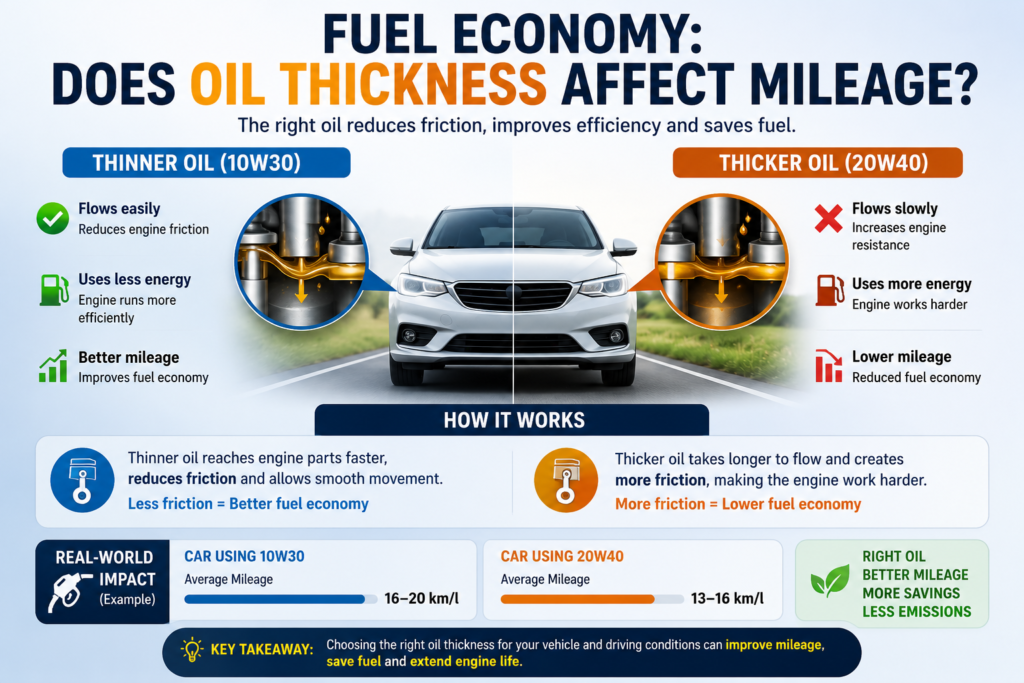
Engine oil influences internal friction.
Thinner oils generally create less resistance as they circulate through the engine. This can contribute to slightly better fuel efficiency in engines designed for lower-viscosity lubricants.
Thicker oils require the oil pump to work a little harder. While the difference may seem small, it can become noticeable over thousands of kilometers.
However, fuel economy should never be the only reason for changing viscosity.
Using oil that is too thin for an older or heavily loaded engine may reduce protection, which costs far more than the small amount of fuel saved.
A balanced decision always considers engine protection first and efficiency second.
Engine Protection: Which Oil Performs Better Over Time?
Many drivers believe thicker oil always protects an engine better. That is only partly true. Protection depends on how well the oil matches the engine’s design and operating conditions.
A modern engine with tight manufacturing tolerances is engineered to work with oil that flows quickly and reaches every moving part within seconds of starting. In such cases, using unnecessarily thick oil can slow lubrication and increase internal resistance.
On the other hand, an older engine with worn piston rings or increased bearing clearances may benefit from a slightly thicker oil film, provided the manufacturer allows it.
The goal is not to choose the thickest oil. The goal is to maintain a stable lubricating film under normal operating conditions.
Practical takeaway: Long-term engine protection comes from using the correct viscosity—not simply a thicker one.
Which Vehicles Usually Use 10W30?
Although you should always follow your owner’s manual, 10W30 is commonly found in:
- Modern petrol cars
- Compact SUVs
- Small diesel vehicles (where specified)
- Hybrid vehicles requiring this viscosity
- Light commercial vehicles in moderate climates
- Motorcycles designed for SAE 30 operating viscosity
It is especially suitable for engines that prioritize fuel efficiency and smooth cold starts.
Which Vehicles Usually Use 20W40?
20W40 is commonly recommended for:
- Older passenger cars
- High-mileage engines
- Some motorcycles
- Agricultural equipment
- Utility vehicles
- Vehicles operating continuously in warm climates
- Engines that regularly carry heavy loads
Some manufacturers also specify 20W40 for certain motorcycles because the oil lubricates both the engine and gearbox.
Practical takeaway: Vehicle type alone does not determine the correct oil. Always verify the recommended viscosity in the owner’s manual.
Pros and Cons of 10W30
| Advantages | Limitations |
|---|---|
| Excellent cold-start lubrication | May not suit some older worn engines |
| Better fuel economy | Thinner film under extreme heat if not specified |
| Fast circulation | Not ideal for every heavy-duty application |
| Suitable for many modern engines | Manufacturer approval is essential |
| Reduced internal friction | May increase oil consumption in worn engines |
Pros and Cons of 20W40
| Advantages | Limitations |
|---|---|
| Strong oil film at high temperatures | Slower circulation during cold starts |
| Suitable for many older engines | Slightly lower fuel efficiency |
| Performs well under heavy loads | Not ideal for very cold climates |
| Often preferred for certain motorcycles | Can increase pumping resistance |
| Helpful for high-mileage engines when recommended | Unsuitable if manufacturer specifies lower viscosity |
Expert Recommendation Box
Professional Recommendation
If your vehicle is less than 10 years old and has been serviced regularly, continue using the viscosity recommended by the manufacturer, even if someone suggests switching to a thicker oil.
Consider changing viscosity only if:
- The owner’s manual allows multiple viscosity grades.
- Your climate has changed significantly.
- A qualified mechanic confirms engine wear.
- The engine has unusually high oil consumption.
Avoid experimenting with oil grades without understanding the reason behind the change.
Decision Checklist Before Buying Engine Oil
Use this quick checklist every time you purchase engine oil.
✅ Check the viscosity recommended in the owner’s manual.
✅ Confirm whether the engine is petrol or diesel.
✅ Consider your local climate.
✅ Check API or ACEA performance specifications.
✅ Look for manufacturer approvals if required.
✅ Buy only sealed products from trusted sellers.
✅ Avoid mixing different viscosity grades unless absolutely necessary.
✅ Replace the oil filter during every oil change.
If you answer “No” to any of these points, pause before buying.
Common Mistakes That Can Damage an Engine
Ignoring the Owner’s Manual
This is the most common mistake.
Manufacturers test engines extensively before recommending a viscosity grade.
Choosing Oil Based Only on Price
Expensive oil is not automatically better.
The right specification matters more than the price tag.
Mixing Different Oil Grades Frequently
Occasional topping up may not cause immediate damage, but regularly mixing viscosities can reduce predictable performance.
Delaying Oil Changes
Even the best engine oil eventually degrades.
Old oil loses its ability to protect against wear and deposits.
Buying Counterfeit Engine Oil
Counterfeit lubricants exist in many markets.
Purchase only from authorized dealers or reputable retailers.
Practical takeaway: Proper maintenance habits often matter more than choosing between 10W30 and 20W40.
Myths vs Facts
| Myth | Reality |
|---|---|
| Thicker oil is always better. | The correct viscosity provides the best protection. |
| Synthetic oil damages old engines. | Synthetic oil is safe if it meets the required specifications. |
| Oil never expires. | Engine oil degrades over time and with use. |
| Mixing different brands always ruins the engine. | Minor mixing is usually acceptable if specifications match, but it should not become routine. |
| Higher viscosity means higher quality. | Viscosity and quality are different characteristics. |
A Simple Roadmap for Choosing the Right Engine Oil
Step 1
Read your owner’s manual.
Step 2
Identify the recommended viscosity grade.
Step 3
Consider your local weather conditions.
Step 4
Evaluate your engine’s mileage and health.
Step 5
Choose oil meeting the required API or ACEA standards.
Step 6
Replace both the oil and filter together.
Step 7
Maintain the recommended service interval.
Following this roadmap removes most of the confusion around engine oil selection.
Frequently Overlooked Factors
Many buyers compare only viscosity while ignoring these important points:
Oil Quality Standards
Look for certifications such as:
- API (American Petroleum Institute)
- ACEA (European Automobile Manufacturers’ Association)
- Manufacturer-specific approvals
Driving Conditions
Frequent towing, dusty roads, mountainous terrain, or heavy traffic can place additional stress on engine oil.
Oil Change Interval
Driving only short distances may require more frequent oil changes because moisture and fuel dilution accumulate inside the engine.
Engine Age
Mileage alone should not determine viscosity.
A well-maintained 200,000 km engine may perform better than a neglected 80,000 km engine.
Future Trends in Engine Oils
The automotive industry is moving toward lower-viscosity lubricants to improve fuel efficiency and reduce emissions.
Manufacturers are increasingly recommending grades such as:
- 0W16
- 0W20
- 5W20
- 5W30
These oils are designed for modern engines with tighter tolerances.
However, 10W30 and 20W40 will continue to remain important for millions of existing vehicles around the world, particularly older cars, motorcycles, and commercial vehicles.
Advances in additive technology are also improving oxidation resistance, sludge control, and wear protection, allowing modern engine oils to perform better than earlier generations with the same viscosity.
Practical takeaway: Future engine oils will become more efficient, but the correct viscosity will always depend on the engine’s design.
Frequently Asked Questions
Can I switch from 20W40 to 10W30?
Yes, but only if your vehicle manufacturer approves both viscosity grades for your engine and climate.
Which oil is better for summer?
In hot climates, 20W40 may provide a thicker oil film in engines designed for it. Always follow the owner’s manual.
Is 10W30 better for fuel economy?
Generally, yes. Lower-viscosity oil creates less internal resistance in engines designed to use it.
Can I use 20W40 in a new car?
Not unless the manufacturer specifically recommends it. Many modern engines require lower-viscosity oils.
Which oil is better for motorcycles?
Some motorcycles are designed for 20W40, while others specify 10W30 or different grades. Always check the service manual.
Does higher mileage automatically require thicker oil?
No. High mileage alone is not enough reason to change viscosity. Engine condition and manufacturer recommendations are more important.
Final Verdict
The difference between 10W30 and 20W40 engine oil is not simply that one is thinner and the other is thicker. Each viscosity grade is designed for specific engines, climates, and operating conditions.
For many modern vehicles, 10W30 offers quicker cold-start protection, smoother circulation, and improved fuel efficiency. For certain older engines, motorcycles, and vehicles operating in consistently hot environments, 20W40 may provide a stronger protective oil film when recommended by the manufacturer.
The smartest approach is to start with your owner’s manual, consider your driving conditions and climate, evaluate your engine’s condition, and choose an oil that meets both the required viscosity and performance standards. Doing so will help maximize engine life, maintain performance, and reduce the risk of costly repairs.
By understanding how engine oil works rather than relying on common myths, you can make a confident, informed decision every time your vehicle is due for an oil change.
You may also like – Tyre Inflation Machine