Modern vehicles are becoming smarter, faster, and more efficient. Yet one small maintenance task still plays a huge role in safety and performance—keeping tyres inflated correctly. While most drivers rely on compressed air, many workshops, commercial fleets, and premium service centers now use a nitrogen tyre inflation machine to deliver more stable tyre pressure.
But does nitrogen really make a difference? Is it worth the investment for a garage or tyre shop? Can an ordinary driver benefit from nitrogen-filled tyres?
This guide answers those questions in simple language. Whether you’re a car owner, workshop operator, or someone planning to purchase a nitrogen tyre inflator machine, you’ll learn how these systems work, when they are useful, and how to choose the right equipment.
Why Tyre Inflation Matters More Than Most Drivers Think
Tyres are the only part of a vehicle that touches the road. Incorrect tyre pressure can affect:
- Fuel economy
- Braking distance
- Steering response
- Tyre lifespan
- Passenger comfort
- Road safety
Even a small pressure drop can increase rolling resistance, causing the engine to work harder and tyres to wear unevenly.
Professional tyre maintenance isn’t just about adding air—it’s about maintaining consistent pressure over time.
Practical takeaway: Before investing in premium tyres, make sure they’re maintained at the correct pressure.
What Is a Nitrogen Tyre Inflation Machine?
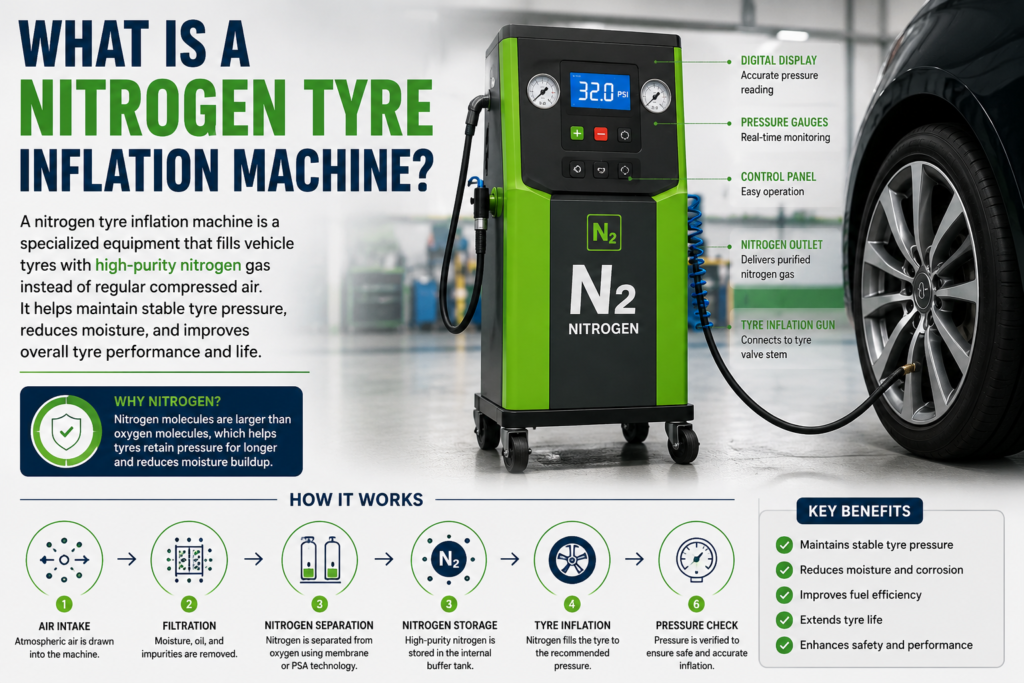
A nitrogen tyre inflation machine is a specialized device that fills vehicle tyres with high-purity nitrogen instead of ordinary compressed air.
Unlike a standard air compressor, this machine separates nitrogen from atmospheric air or stores it from a nitrogen cylinder before delivering it into tyres.
Most professional systems produce nitrogen purity between:
| Machine Type | Typical Nitrogen Purity |
|---|---|
| Entry-Level | 95% |
| Mid-Range | 97–98% |
| Premium Workshop Systems | 99%+ |
Higher purity generally provides more stable tyre pressure and lower moisture content.
Practical takeaway: For most passenger vehicles, purity above 95% is suitable.
Understanding the Science Behind Nitrogen Inflation
Air already contains approximately:
- 78% Nitrogen
- 21% Oxygen
- Small amounts of carbon dioxide
- Water vapor
- Other gases
A nitrogen machine removes most oxygen and moisture before inflation.
Why does that matter?
Oxygen molecules escape through rubber faster than nitrogen molecules. Moisture inside tyres also expands and contracts more with temperature changes.
By reducing both oxygen and moisture, nitrogen helps maintain more consistent tyre pressure.
This doesn’t mean tyres never lose pressure—they simply lose it more slowly.
Components of a Nitrogen Tyre Inflator Machine
Most machines contain several integrated systems.
Air Compressor
Provides compressed air for processing.
Moisture Removal Unit
Eliminates water vapor before gas separation.
Filtration System
Removes oil particles, dust, and contaminants.
Nitrogen Generator
Separates nitrogen using membrane or PSA technology.
Pressure Control Module
Ensures accurate inflation according to manufacturer specifications.
Digital Display
Shows pressure readings and machine status.
Automatic Inflation Gun
Allows quick and precise tyre filling.
Practical takeaway: Better filtration generally means longer machine life and cleaner nitrogen output.
How a Nitrogen Tyre Inflation Machine Works
The process is surprisingly simple.
- Atmospheric air enters the compressor.
- Moisture and contaminants are filtered out.
- Nitrogen is separated from oxygen.
- High-purity nitrogen is stored.
- Old air is partially removed from the tyre.
- Nitrogen fills the tyre to the desired pressure.
- Pressure is verified digitally.
Many modern machines complete this process automatically.
Where Nitrogen Inflation Is Commonly Used
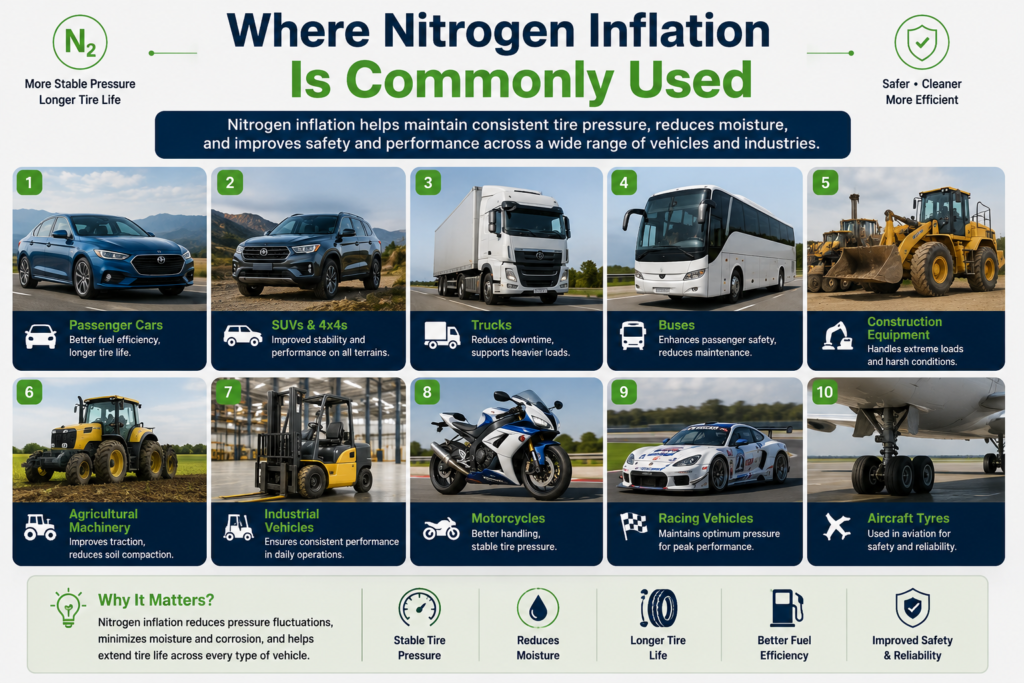
Nitrogen isn’t limited to luxury vehicles.
Common applications include:
- Passenger cars
- SUVs
- Electric vehicles
- Motorcycles
- Trucks
- Buses
- Construction equipment
- Agricultural machinery
- Racing vehicles
- Aircraft tyres
Commercial fleets especially value pressure stability because tyre maintenance directly affects operating costs.
Benefits of Using Nitrogen in Tyres
More Stable Pressure
Nitrogen escapes more slowly than oxygen, helping tyres maintain recommended pressure longer.
Improved Fuel Efficiency
Proper tyre pressure reduces rolling resistance.
Longer Tyre Life
Even inflation promotes uniform tread wear.
Less Internal Corrosion
Reduced oxygen helps protect steel belts inside tyres.
Lower Moisture Content
Dry nitrogen minimizes pressure changes caused by temperature fluctuations.
Better Performance During Long Drives
High-speed highway travel generates heat. Nitrogen reduces pressure variation compared to moist compressed air.
Practical takeaway: Nitrogen supports proper tyre maintenance but does not replace regular pressure checks.
Comparison Table: Nitrogen vs Compressed Air
| Feature | Nitrogen | Compressed Air |
|---|---|---|
| Pressure Retention | Better | Good |
| Moisture | Very Low | Higher |
| Internal Corrosion | Reduced | More Likely |
| Cost | Higher | Lower |
| Availability | Limited | Everywhere |
| Maintenance Frequency | Lower | Slightly Higher |
| Best for Long Trips | Yes | Yes |
Common Myths About Nitrogen Tyres
Myth: Nitrogen prevents punctures.
Fact: It has no effect on punctures.
Myth: Nitrogen eliminates tyre maintenance.
Fact: Pressure should still be checked monthly.
Myth: Nitrogen improves grip.
Fact: Grip depends on tyre quality, tread, and road conditions.
Myth: Air and nitrogen cannot mix.
Fact: Mixing is safe, although nitrogen purity decreases.
Myth: Every driver needs nitrogen.
Fact: Benefits are greater for commercial vehicles, performance cars, and high-mileage drivers.
Who Should Consider a Nitrogen Tyre Inflation Machine?
A nitrogen system can be valuable for:
- Tyre retailers
- Vehicle service centers
- Automobile dealerships
- Fleet operators
- Bus depots
- Logistics companies
- Premium car workshops
- Racing teams
For home users, the investment is usually unnecessary unless maintaining multiple vehicles.
Types of Nitrogen Tyre Inflation Machines
Portable Units
Compact and suitable for small workshops.
Advantages:
- Easy to move
- Lower cost
- Simple installation
Wall-Mounted Systems
Designed for medium-sized service centers.
Advantages:
- Saves floor space
- Continuous operation
- Professional appearance
Industrial Models
Used by commercial fleets and tyre manufacturers.
Advantages:
- High output
- Faster inflation
- Supports multiple service bays
Buying Checklist
Before purchasing, evaluate:
✔ Nitrogen purity
✔ Inflation speed
✔ Daily operating capacity
✔ Power consumption
✔ Filter replacement schedule
✔ Digital pressure accuracy
✔ Warranty support
✔ Availability of spare parts
✔ Service network
✔ Operating cost
Practical takeaway: The cheapest machine often becomes the most expensive if maintenance costs are high.
Comparison Table: Choosing the Right Machine
| User Type | Recommended Machine |
|---|---|
| Small Garage | Portable Unit |
| Tyre Shop | Wall-Mounted Model |
| Multi-Bay Workshop | Automatic Generator |
| Commercial Fleet | Industrial Generator |
| Luxury Dealership | Premium Digital System |
Installation Considerations
Professional installation improves reliability.
Ensure:
- Stable electrical supply
- Clean working environment
- Proper ventilation
- Easy filter access
- Adequate compressor capacity
- Routine servicing schedule
Ignoring installation guidelines can reduce nitrogen purity.
Maintenance Requirements
Routine maintenance includes:
- Replacing filters
- Cleaning moisture separators
- Checking pressure sensors
- Inspecting hoses
- Calibrating gauges
- Monitoring nitrogen purity
Most manufacturers recommend preventive servicing rather than waiting for breakdowns.
Common Mistakes to Avoid
Many users reduce machine efficiency through poor maintenance.
Avoid these mistakes:
- Ignoring filter replacement
- Using contaminated air supply
- Skipping calibration
- Overinflating tyres
- Assuming nitrogen removes the need for inspections
- Buying machines without local service support
Practical takeaway: Preventive maintenance costs far less than unexpected repairs.
Real-World Example
Consider two taxi fleets operating similar vehicles.
Fleet A uses standard compressed air.
Fleet B maintains tyres with nitrogen and follows monthly inspections.
After thousands of highway miles, Fleet B often experiences:
- More consistent tyre pressure
- More even tread wear
- Fewer pressure adjustments
- Reduced downtime for tyre servicing
The biggest savings come not from nitrogen alone but from combining it with disciplined maintenance.
Costs Involved
The price of a nitrogen tyre inflator machine depends on:
- Nitrogen purity
- Automation level
- Tank capacity
- Compressor quality
- Display technology
- Production capacity
- Brand reputation
Operating costs include:
- Electricity
- Filter replacement
- Scheduled servicing
- Calibration
- Spare parts
Businesses should evaluate long-term operating costs rather than purchase price alone.
Industry Trends
Several trends are shaping tyre inflation technology.
Smart Inflation Systems
Machines automatically detect required tyre pressure.
IoT Monitoring
Connected systems report maintenance needs remotely.
Digital Fleet Management
Commercial operators track tyre pressure across hundreds of vehicles.
Energy-Efficient Compressors
New compressors reduce electricity consumption.
EV-Compatible Systems
Electric vehicles place greater importance on precise tyre pressure because it directly affects driving range.
Expert Recommendation
If you operate a tyre shop serving dozens of vehicles daily, a high-quality nitrogen tyre inflation machine can improve customer service and reduce repeat pressure complaints. However, success depends on correct operation, regular servicing, and educating customers about realistic benefits. Nitrogen is a maintenance enhancement—not a miracle solution.
Quick Summary
| Question | Answer |
|---|---|
| Is nitrogen better than air? | It offers better pressure stability. |
| Does it prevent punctures? | No. |
| Does it increase tyre life? | It may help when pressure remains consistent. |
| Is maintenance still required? | Yes. |
| Best users? | Workshops, fleets, premium service centers. |
| Worth buying? | Yes, for businesses with regular tyre service demand. |
Frequently Asked Questions
How often should nitrogen tyres be checked?
At least once every month, just like air-filled tyres.
Can I switch back to normal air?
Yes. There is no damage from switching between nitrogen and compressed air.
Does nitrogen improve fuel economy?
Indirectly. Stable tyre pressure can help maintain optimal fuel efficiency.
Can motorcycles use nitrogen?
Yes. Many premium motorcycles use nitrogen-filled tyres.
Is nitrogen safe?
Yes. Nitrogen is an inert, non-flammable gas and is widely used across automotive and aviation industries.
Do electric vehicles benefit from nitrogen?
Many EV owners choose nitrogen because consistent tyre pressure helps maintain efficiency and driving range.
Conclusion
A nitrogen tyre inflation machine is more than a premium workshop accessory. It is a practical investment for businesses that prioritize tyre performance, customer satisfaction, and long-term maintenance quality. While nitrogen does not eliminate tyre wear or replace routine inspections, it supports more stable pressure, reduces moisture-related issues, and helps maintain consistent performance over time.
For individual drivers, the decision depends on driving habits and access to nitrogen services. For tyre shops, dealerships, and commercial fleets, however, a reliable nitrogen tyre inflator machine can enhance service quality and reinforce a professional maintenance program. The best results come from pairing quality equipment with regular inspections, accurate pressure checks, and manufacturer-recommended tyre care. Check our home page and stay tune for upcoming blogs dgmnews6.com.