Going to work should never mean risking your personal safety. Yet workplace assaults can happen in almost any industry, from healthcare and retail to hospitality, transportation, education, and office environments. Whether an assault is committed by a customer, co-worker, manager, contractor, or another individual, the impact often extends far beyond physical injuries. Emotional trauma, lost income, medical expenses, and uncertainty about legal rights can leave victims feeling overwhelmed.
Understanding assault at work compensation is not simply about receiving financial support. It is about knowing which options may be available, documenting the incident correctly, and taking informed steps toward recovery.
Because employment laws, workers’ compensation systems, and personal injury rules differ across countries and jurisdictions, this guide provides general educational information. If you’ve been assaulted at work, seeking advice from a qualified legal professional in your area is the safest way to understand your specific rights.
Assault at work compensation may be available to employees injured by workplace violence, depending on local laws. Compensation can include medical expenses, lost income, rehabilitation costs, and psychological injuries. Reporting the incident promptly, preserving evidence, and seeking medical care are essential steps that may strengthen a future claim.
Understanding Workplace Assault Beyond Physical Violence
Many people picture workplace assault as a physical attack that results in visible injuries. In reality, assault-related incidents can involve different forms of harmful conduct depending on local legal definitions.
Examples include:
- Physical attacks causing injury
- Attempted physical violence
- Threats that create immediate fear of harm
- Violence involving workplace visitors
- Customer or client aggression
- Repeated violent harassment escalating into assault
One important point many employees overlook is that criminal proceedings and compensation claims are often separate matters. Even if criminal charges are not filed or do not lead to a conviction, compensation may still be available under certain workplace injury or civil claim processes.
Practical takeaway: Always report any violent incident, even if injuries initially seem minor.
Who May Be Responsible When an Assault Happens at Work?

Responsibility depends on how the incident occurred and the laws in the relevant country. More than one party may share responsibility.
Possible responsible parties include:
| Situation | Potential Responsibility |
|---|---|
| Attack by another employee | Individual attacker and possibly employer |
| Customer violence | Employer if reasonable safety measures were lacking |
| Security failure | Employer or contracted security provider |
| Third-party criminal attack | Depends on workplace security obligations |
| Domestic violence entering workplace | Varies according to employer policies and local law |
The key question often becomes whether the employer took reasonable steps to reduce foreseeable risks.
For example, if employees repeatedly reported violent customers but no security improvements were made, investigators may examine whether the employer met workplace safety obligations.
Practical takeaway: Responsibility is not always limited to the person who committed the assault.
When Could You Be Eligible for Assaulted at Work Compensation?
Eligibility depends on local laws, insurance systems, and the facts of the incident.
Common situations that may qualify include:
- Assault while performing normal job duties
- Violence during work-related travel
- Attack while protecting another employee
- Customer or client violence
- Robbery occurring during work
- Violence resulting from inadequate workplace security
- Assault during employer-authorized activities
Some claims may also include psychological injuries when supported by appropriate medical evidence.
Situations That Can Make Claims More Complicated
Certain circumstances require additional legal evaluation:
- Personal disputes unrelated to work
- Incidents occurring after work hours
- Assault while violating workplace rules
- Intoxication or criminal conduct by the injured employee
- Delayed reporting
These situations do not automatically prevent compensation, but they often require more detailed investigation.
Practical takeaway: Early legal advice can help clarify whether your situation falls within applicable compensation rules.
A Five-Step Response Framework After a Workplace Assault
Many people focus only on calling the police or informing their employer. Both are important, but a complete response involves several actions.
Step 1: Prioritize Immediate Safety
Move away from danger.
Seek emergency assistance if necessary.
Do not remain in an unsafe environment simply to gather evidence.
Step 2: Obtain Medical Assessment
Even minor injuries deserve professional evaluation.
Medical records often become valuable evidence if compensation is later pursued.
Some injuries—particularly concussions and internal injuries—may not appear immediately.
Step 3: Report the Incident
Notify:
- Supervisor
- HR department
- Workplace safety officer
- Security personnel
- Police where appropriate
Request a written copy of the incident report if available.
Step 4: Preserve Evidence
Useful evidence may include:
- CCTV footage
- Witness names
- Photographs
- Damaged clothing
- Medical reports
- Emails
- Security logs
Step 5: Keep a Recovery Journal
One frequently overlooked step is recording:
- Pain levels
- Medical appointments
- Missed work
- Emotional symptoms
- Sleep disturbances
- Medication effects
A detailed recovery journal may help demonstrate how the assault affected daily life.
Practical takeaway: Evidence gathered during the first few days can significantly influence the strength of a future claim.
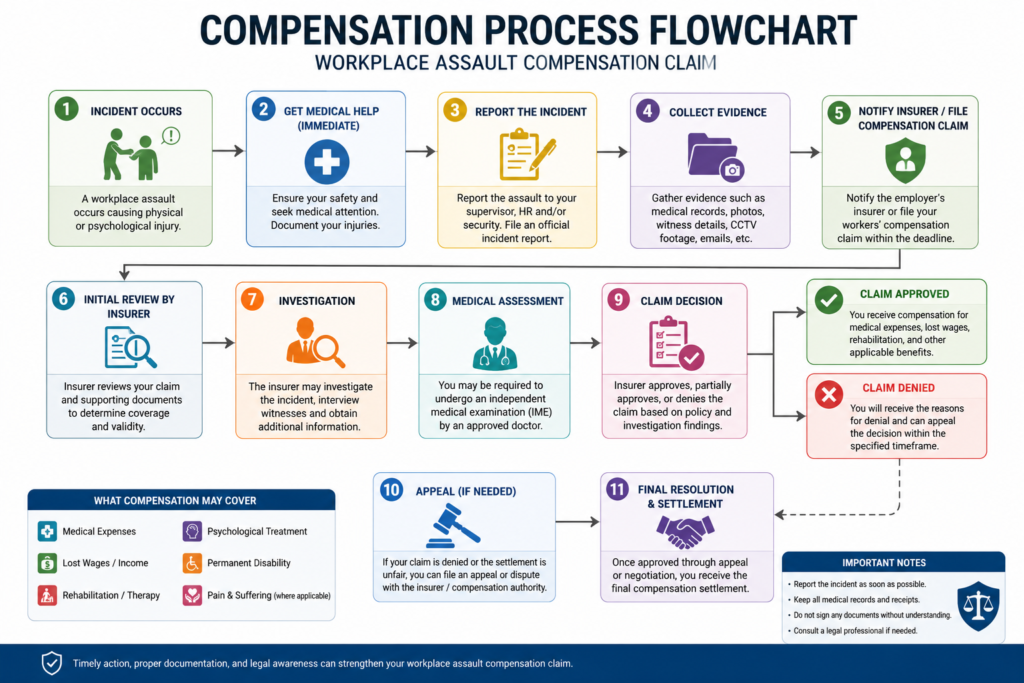
What Types of Compensation Might Be Available?
Many people ask, “How much compensation for assault at work?”
There is no universal amount because compensation depends on multiple factors.
Possible areas of compensation may include:
Medical Costs
These may include:
- Emergency treatment
- Hospital care
- Surgery
- Rehabilitation
- Medication
- Specialist consultations
- Psychological treatment
Lost Income
If injuries prevent working, compensation may include:
- Lost wages
- Reduced earning capacity
- Future income losses
Pain and Suffering
Some legal systems recognize compensation for:
- Physical pain
- Emotional distress
- Loss of quality of life
Availability varies depending on jurisdiction.
Rehabilitation Expenses
Recovery sometimes requires:
- Physiotherapy
- Occupational therapy
- Counseling
- Workplace retraining
Permanent Disability
Serious assaults may result in:
- Permanent impairment
- Long-term disability
- Career limitations
These cases generally involve more complex compensation assessments.
Compensation Categories at a Glance
| Compensation Type | What It May Cover |
|---|---|
| Medical expenses | Treatment and recovery costs |
| Income replacement | Lost wages during recovery |
| Future losses | Reduced earning ability |
| Rehabilitation | Therapy and vocational support |
| Psychological injury | Mental health treatment where recognized |
| Permanent impairment | Long-term disability compensation |
Practical takeaway: Compensation often includes much more than immediate medical bills.
An Original Decision Checklist: Is It Time to Seek Legal Advice?
Use the checklist below.
✔ You required medical treatment.
✔ You missed work.
✔ The employer failed to address previous safety concerns.
✔ The assault caused ongoing anxiety.
✔ CCTV footage exists.
✔ Witnesses observed the incident.
✔ You suffered lasting physical injuries.
✔ The employer disputes what happened.
✔ Insurance representatives have contacted you.
✔ You are unsure what documents to sign.
If several of these apply, obtaining independent legal advice is generally a sensible next step.
Psychological Injuries Matter Too
Not every workplace assault leaves visible injuries.
Many employees experience:
- Anxiety
- Panic attacks
- Depression
- Sleep disruption
- Fear of returning to work
- Post-traumatic stress symptoms
These effects can last months or even years if untreated.
Employers increasingly recognize that recovery involves both physical and mental health support.
Professional mental health treatment is just as important as treating physical injuries.
Practical takeaway: Never ignore emotional symptoms after a violent workplace incident. Early treatment can improve recovery and create appropriate medical documentation if needed.
Mini Case Study: When Good Documentation Changed the Outcome

Imagine a retail employee who is assaulted during an attempted robbery.
Initially, the injuries appear limited to bruising. The employee reports the incident immediately, visits a hospital the same day, requests copies of medical records, keeps photographs of injuries, and maintains a recovery diary documenting recurring headaches and anxiety.
Several weeks later, medical specialists diagnose a concussion and recommend ongoing treatment. Because the incident was reported promptly and supported by medical evidence, witness statements, and security footage, the employee has a much stronger foundation for pursuing available workplace benefits or legal remedies than someone who delayed reporting or failed to preserve evidence.
The lesson is simple: thorough documentation can be just as important as the injury itself when establishing a compensation claim.
Common Mistakes That Can Weaken a Compensation Claim
Even valid claims can become more difficult when important steps are missed. Some of the most common mistakes include:
- Waiting too long to report the assault.
- Assuming minor injuries do not require medical attention.
- Failing to collect witness contact details.
- Posting details of the incident on social media before receiving legal advice.
- Signing insurance or settlement documents without understanding their implications.
- Returning to physically demanding work before receiving medical clearance.
- Keeping no record of medical appointments, expenses, or lost income.
Avoiding these mistakes can make it easier to demonstrate what happened and how the incident affected your health, finances, and ability to work.
Practical takeaway: Acting promptly, documenting carefully, and seeking professional guidance when needed are among the most effective ways to protect your rights after a workplace assault.
Comparing Workers’ Compensation and Personal Injury Claims
Many people assume that every workplace assault leads to the same type of compensation claim. In reality, the legal path often depends on who caused the assault, where it happened, and the laws in your country or region.
A workers’ compensation claim is generally designed to provide benefits for employees injured while performing their job, regardless of who was at fault in many jurisdictions. A personal injury claim, on the other hand, usually focuses on proving that another party’s negligence contributed to the incident.
Some situations may involve both types of claims, while others may allow only one. The available options vary depending on local legislation.
| Feature | Workers’ Compensation | Personal Injury Claim |
|---|---|---|
| Main purpose | Covers workplace injuries and recovery | Seeks compensation from a responsible party |
| Fault requirement | Often not required, depending on local law | Usually requires proving negligence or liability |
| Medical expenses | Frequently covered | May be claimed as damages |
| Lost income | Often includes wage replacement benefits | May include past and future income losses |
| Pain and suffering | Not always available | May be available in some jurisdictions |
| Time frame | Often follows administrative procedures | Usually handled through civil legal processes |
Understanding the difference helps employees ask better questions when speaking with employers, insurers, or legal professionals.
Practical takeaway: Never assume you only have one compensation option. Ask which legal pathways may apply to your situation.
How Compensation Amounts Are Usually Evaluated
One of the most searched questions is, “How much compensation for assault at work?”
There is no fixed amount because every case is assessed individually. Two people with similar injuries may receive different outcomes depending on several factors.
Professionals often consider:
- The severity of physical injuries.
- The length of medical treatment.
- Whether surgery was required.
- Time away from work.
- Long-term disability or permanent impairment.
- Emotional or psychological effects.
- Future medical expenses.
- Reduced earning capacity.
- Available medical evidence.
- Applicable laws in the relevant jurisdiction.
For example, a worker who recovers fully after several weeks will likely have a different claim from someone who develops permanent mobility problems or ongoing post-traumatic stress symptoms.
Practical takeaway: Compensation is based on evidence, not estimates found online.
Can Psychological Trauma Lead to Compensation?
Yes, in many legal systems psychological injuries may form part of a workplace compensation claim when supported by appropriate medical evidence.
Examples include:
- Post-traumatic stress disorder (PTSD)
- Anxiety disorders
- Depression
- Panic disorder
- Adjustment disorder
- Chronic sleep disturbances linked to the assault
Mental health injuries should be diagnosed by qualified healthcare professionals rather than self-diagnosed.
Employers in many countries are becoming more aware that workplace violence can affect productivity, confidence, and long-term wellbeing even when physical injuries appear minor.
Early counselling and psychological support may improve recovery while also creating an accurate medical record of symptoms.
Practical takeaway: Emotional recovery deserves the same attention as physical recovery.
Employer Responsibilities After Workplace Violence
Most employers have legal duties to provide a reasonably safe working environment, although the exact obligations vary by country.
Good workplace practices often include:
- Conducting regular workplace risk assessments.
- Providing violence prevention training.
- Installing appropriate security systems.
- Maintaining emergency reporting procedures.
- Investigating every reported incident.
- Supporting injured employees during recovery.
- Reviewing workplace policies after serious incidents.
Employers who learn from violent incidents are often better prepared to prevent similar events in the future.
Expert Recommendation Box
If you have experienced an assault at work, focus on these priorities in order:
- Ensure your immediate safety.
- Seek professional medical care.
- Report the incident promptly.
- Preserve every piece of available evidence.
- Follow medical advice carefully.
- Keep records of expenses and lost income.
- Understand local reporting deadlines.
- Seek independent legal advice if your injuries are serious or liability is disputed.
Taking these steps early can strengthen both your recovery and any future compensation process.
Preventing Workplace Assault: Practical Strategies That Benefit Everyone
While no workplace can eliminate every risk, prevention significantly reduces the likelihood of violent incidents.
Effective prevention measures include:
- Better employee training.
- Clear reporting systems.
- Security cameras in high-risk areas.
- Controlled building access.
- Adequate staffing levels.
- Conflict de-escalation training.
- Panic alarms where appropriate.
- Regular reviews of previous incidents.
- Strong anti-violence workplace policies.
Employees also play an important role by reporting threats early rather than assuming someone else will handle the situation.
Myths vs Facts About Assault at Work Compensation
| Myth | Fact |
|---|---|
| Minor injuries are never worth reporting. | Even minor injuries can develop into more serious medical conditions. |
| Compensation is only available if criminal charges are filed. | Criminal and compensation processes are often separate. |
| Mental health injuries never count. | Psychological injuries may be recognized when supported by medical evidence. |
| Only dangerous jobs experience workplace assaults. | Workplace violence can occur in almost any industry. |
| Waiting several months to report an assault has no consequences. | Delays may make evidence harder to obtain and complicate a claim. |
Understanding these misconceptions helps employees make informed decisions rather than relying on inaccurate advice.
Implementation Roadmap: From Incident to Recovery
The days and weeks after a workplace assault can feel overwhelming. Following a structured plan can help you stay organized.
Immediately after the incident
- Move to a safe location.
- Contact emergency services if required.
- Notify your supervisor.
- Seek medical attention.
Within the first 24 hours
- Complete an incident report.
- Photograph visible injuries.
- Collect witness information.
- Save relevant emails or messages.
During the following weeks
- Attend all medical appointments.
- Keep receipts and expense records.
- Maintain a recovery journal.
- Communicate regularly with your employer if you are unable to work.
If recovery becomes prolonged
- Obtain updated medical assessments.
- Discuss workplace adjustments if returning to work.
- Seek legal advice if compensation questions remain unresolved.
Following a clear roadmap reduces confusion during an already stressful period.
Future Trends in Workplace Violence Prevention and Compensation
Workplaces continue to evolve, and so do approaches to employee safety.
Several trends are becoming increasingly important:
- Greater use of AI-powered security monitoring.
- Improved mental health support programs.
- Enhanced reporting systems through mobile applications.
- Better violence prevention training.
- Increased focus on psychosocial workplace risks.
- Stronger employer accountability for workplace safety.
- More comprehensive employee wellbeing initiatives.
These developments suggest that future workplace safety efforts will place equal importance on prevention, rapid response, and long-term employee recovery.
Key Takeaways
Experiencing an assault at work can affect your physical health, emotional wellbeing, finances, and confidence. While compensation cannot erase the experience, understanding your rights and acting quickly can make the recovery process more manageable.
The most important steps include reporting the incident promptly, seeking medical care, preserving evidence, and keeping detailed records throughout your recovery. Because employment and compensation laws differ between countries and jurisdictions, obtaining advice from a qualified legal professional is the best way to understand your specific options.
Above all, remember that workplace violence should never be accepted as “part of the job.” Every employee deserves a safe working environment, and employers, workers, and policymakers all share responsibility for creating safer workplaces.
Frequently Asked Questions
Can I claim compensation if I was assaulted by a customer at work?
In many jurisdictions, yes. If you were assaulted while carrying out your work duties, you may be eligible to pursue workers’ compensation, employer-provided benefits, or other legal remedies depending on local laws and the circumstances. Whether the employer took reasonable steps to reduce foreseeable risks may also be relevant in some cases.
What if my employer says the assault was a personal matter?
The answer depends on the facts. If the incident arose directly from your work or occurred while you were performing your job, it may still qualify as a workplace incident even if the attacker was someone you knew. A legal professional can assess how local laws apply to your situation.
Can I receive compensation for emotional distress after a workplace assault?
Many legal systems recognize psychological injuries when supported by medical evidence. Conditions such as post-traumatic stress disorder (PTSD), anxiety, depression, or panic disorders may be considered as part of a compensation claim, depending on the applicable laws.
How long do I have to file an assault at work compensation claim?
Time limits vary significantly between countries, states, and compensation systems. Some deadlines may be only a few months, while others are longer. Reporting the incident and seeking legal advice as soon as possible helps protect your rights.
Will reporting the assault affect my job?
Most countries have employment laws that protect workers from retaliation for reporting workplace safety incidents. However, those protections vary by jurisdiction. If you believe you are being treated unfairly after reporting an assault, seek legal advice promptly.
Can I return to work before I have fully recovered?
Returning to work too early may delay recovery or worsen your condition. Always follow your healthcare provider’s recommendations. If available, discuss temporary workplace adjustments or modified duties with your employer.
What evidence is most useful in an assault at work compensation claim?
Helpful evidence often includes:
- Medical records
- Incident reports
- CCTV footage
- Witness statements
- Police reports, where applicable
- Photographs of injuries
- Emails or messages related to the incident
- Records of lost wages and medical expenses
The stronger and more organized your documentation, the easier it is to explain what happened.
Is compensation guaranteed after a workplace assault?
No. Every claim is assessed individually. Eligibility depends on the facts of the incident, available evidence, applicable laws, medical findings, and the relevant compensation system. Because each case is unique, no outcome can be guaranteed.
Final Thoughts
A workplace assault can change your life in ways that extend far beyond the incident itself. Physical injuries may heal, but emotional trauma, financial stress, and uncertainty about your future can remain long after the event.
Understanding how assault at work compensation works is the first step toward protecting your rights. Reporting the incident promptly, obtaining medical care, preserving evidence, and following professional advice can significantly improve both your recovery and your ability to pursue any available compensation.
It is equally important to remember that every country has its own employment laws, workers’ compensation rules, and civil liability standards. Information found online should be treated as general guidance rather than personal legal advice. If your injuries are serious, your claim is disputed, or you are unsure about your options, speaking with a qualified employment or personal injury lawyer in your jurisdiction is often the most reliable course of action.
A safe workplace is not a privilege—it is a fundamental expectation. Employers, employees, and policymakers all play a role in reducing workplace violence through better prevention, stronger reporting systems, effective training, and ongoing support for those affected.
By acting quickly, keeping accurate records, and understanding your legal options, you can focus on what matters most: your recovery, your wellbeing, and your future.