Searches for the best blood purifier syrup for glowing skin often begin with a familiar problem. Someone notices pimples, uneven texture, dark spots or tired-looking skin and assumes toxins or “dirty blood” must be responsible.
Advertisements strengthen this belief. They present herbal syrups as simple internal cleansers that can remove toxins, prevent acne and produce naturally glowing skin.
The medical reality is different.
“Blood purifier” is not a clearly defined medical treatment. In a healthy body, the liver processes many substances while the kidneys filter waste from the blood. Acne, pigmentation, dryness and dullness do not normally mean that the blood needs to be cleaned.
Some herbal syrups contain plants traditionally used for skin or digestive concerns. That does not automatically make every product ineffective. However, traditional use alone cannot prove that a particular commercial formula will clear acne or brighten the skin. The ingredients, dose, product quality, health history and real cause of the skin problem all matter.
Therefore, the best choice is not necessarily the most popular or bitter-tasting syrup. It is the option that is transparent, reasonably supported, safe for the individual and appropriate for the actual concern.
There is no single proven blood purifier syrup for glowing skin. Acne and dullness usually involve clogged pores, dryness, sun exposure, irritation or hormonal factors—not dirty blood. Start with sunscreen, moisturiser and targeted skincare. Review any herbal syrup’s ingredients, safety, interactions and manufacturing quality before using it.
Quick Answer: Is There a Best Blood Purifier Syrup?
There is no single blood purifier syrup scientifically established as the best choice for glowing skin.
For most people, a simple routine containing a gentle cleanser, suitable moisturiser and broad-spectrum sunscreen is more predictable than a detox syrup. Targeted treatment may be necessary when the problem is acne, pigmentation, eczema, hormonal changes or another skin condition.
A syrup should never replace proper diagnosis or proven treatment.
| Skin concern | Is a blood purifier likely to solve it? | More suitable first step |
|---|---|---|
| Dry and rough skin | Usually no | Gentle cleanser and moisturiser |
| Blackheads and clogged pores | Limited benefit | Salicylic acid or acne treatment |
| Painful acne | Unlikely | Dermatologist or doctor |
| Sun-related darkening | No | Broad-spectrum sunscreen |
| Sudden rash | Not appropriate | Medical assessment |
| Tired-looking skin | Uncertain | Sleep, nutrition and simple skincare |
| Suspected deficiency | Only if confirmed | Tests and professional advice |
Practical takeaway: Identify the skin problem before selecting an oral product.
What Does “Blood Purifier” Really Mean?
The term “blood purifier” is commonly used in herbal, traditional and wellness marketing. It does not describe one standard formula or one medically recognised treatment.
One syrup may contain neem and turmeric. Another may contain aloe vera, manjistha, sariva, vitamins, minerals, sweeteners and several additional extracts.
This creates an important problem: two products marketed for the same purpose may have completely different ingredients, doses, risks and quality standards.
The World Health Organization recognises that traditional medicine may contribute to healthcare, but it also stresses the importance of scientific validation, safety and reliable evidence. Long-term traditional use should not be treated as automatic proof that a product is effective or harmless.
A syrup may support general wellness in some users, but it should not be described as literally cleaning unhealthy blood unless there is a medically diagnosed condition requiring treatment.
Why Acne and Dull Skin Develop
Understanding the cause helps prevent wasted money and delayed treatment.
Clogged Pores and Inflammation
Acne develops when hair follicles become blocked with oil and dead skin cells. Bacteria and inflammation may also contribute. Blood impurity is not recognised as the usual cause.
For mild to moderate acne, treatments such as benzoyl peroxide may be recommended. It helps reduce acne-related bacteria, whiteheads, blackheads and inflammation. It can also cause dryness or irritation, so it must be used carefully.
Sun Exposure
Sunlight can worsen tanning, uneven pigmentation and visible signs of premature ageing.
Dermatologists recommend a broad-spectrum, water-resistant sunscreen with SPF 30 or higher. Sunscreen protects against UVA and UVB radiation and is more relevant to preventing sun-related dullness than an oral detox product.
Skin-Barrier Damage
Strong face washes, scrubbing, alcohol-based products and excessive exfoliation can damage the skin barrier.
Once irritated, the skin may feel tight, appear rough and develop more visible redness or pigmentation. Scrubbing acne-prone skin can also aggravate breakouts.
Hormonal Factors
Recurring jawline acne, irregular menstrual cycles, sudden facial hair growth or unexplained weight changes can suggest a hormonal issue.
A general herbal syrup may not correct this underlying cause. Medical evaluation is more useful than repeatedly changing detox products.
Nutrition and Lifestyle
Poor sleep, smoking, unbalanced meals and chronic stress may influence overall appearance and some skin conditions.
A varied diet containing vegetables, fruit, legumes, whole grains, nuts, seeds and suitable protein sources supports general health and supplies important nutrients.
However, no single food, juice or syrup can guarantee glowing skin.
The CLEAR Framework for Choosing a Blood Purifier Syrup
Click each section below before purchasing any blood purifier syrup.
Look for realistic health claims.
- ❌ “Instant glowing skin”
- ❌ “Permanent acne cure”
- ❌ “100% toxin removal”
- ❌ “Works for everyone”
- ✅ Honest, evidence-based descriptions
Tip: Be cautious of products promising dramatic overnight results.
- Complete ingredient list
- Dosage information
- Manufacturer details
- Batch number
- Expiry date
- Safety warnings
Tip: Avoid products with undisclosed “proprietary” or “secret” herbal blends.
- Check trusted medical organizations.
- Read scientific evidence where available.
- Don’t rely only on customer testimonials.
- Traditional use doesn’t automatically prove effectiveness.
Tip: Evidence should support the complete formula—not just one ingredient.
- Possible allergies
- Medicine interactions
- Pregnancy or breastfeeding concerns
- Liver or kidney disease
- Existing medical conditions
Tip: “Natural” does not always mean safe.
- Is your concern acne?
- Is it dryness?
- Is it pigmentation?
- Could hormones be involved?
- Would a dermatologist be more appropriate?
Tip: Treat the actual skin problem rather than assuming your blood needs purification.
Blood Purifier Syrup vs Targeted Skincare
| Decision factor | Blood purifier syrup | Targeted skincare |
|---|---|---|
| Main purpose | General or traditional wellness | Treating a defined skin concern |
| Evidence | Depends heavily on the formula | Better established for several active ingredients |
| Personalisation | Usually low | Can match acne, dryness or pigmentation |
| Side effects | Digestive problems, allergy or interactions | Mostly irritation when incorrectly used |
| Result tracking | Difficult | Easier when one active is introduced |
| Best role | Optional support after safety checks | First-line care for many common concerns |
| Professional guidance | Important with medicines or illness | Important for severe or persistent conditions |
A syrup may appear easier because it requires only one or two daily doses. But convenience is not proof of effectiveness.
Practical takeaway: Match the solution to the cause rather than choosing the product with the broadest claims.
The CLEAR Framework for Choosing a Syrup
Before buying a blood purifier, use the original CLEAR framework.
C — Check the Claim
Be cautious when the label promises to:
- remove every toxin;
- permanently cure acne;
- lighten natural skin colour;
- provide results within a few days;
- treat several unrelated diseases;
- work without diet or skincare changes.
Reliable health products use specific, limited language. Cure-all promises are a warning sign.
L — Read the Label
The label should clearly state:
- complete ingredients;
- quantity of major ingredients;
- recommended serving;
- manufacturer details;
- batch number;
- expiry date;
- storage method;
- warnings;
- added sugar or sweeteners.
Avoid products that hide ingredients behind phrases such as “secret herbal blend.”
E — Examine the Evidence
Evidence for one laboratory-tested plant does not prove that a multi-herb syrup works in humans.
Ask whether the complete product has been studied, not merely whether one ingredient has antioxidant or antimicrobial properties.
A — Assess the Risks
Herbal ingredients can have strong biological effects. Dietary supplements may interact with medicines, interfere with laboratory tests or create problems around surgery.
Extra care is needed for people who:
- take prescription medicines;
- have diabetes;
- have liver or kidney disease;
- use blood-thinning medicines;
- are pregnant or breastfeeding;
- are preparing for surgery;
- have a history of allergies.
R — Review the Real Need
Ask what the syrup is supposed to fix.
Dry skin needs moisture. Clogged pores need suitable acne care. Sun-related pigmentation requires sunscreen. A widespread rash may require medical treatment.
The more clearly the concern is defined, the easier it becomes to avoid unnecessary products.
Common Blood Purifier Ingredients
Blood purifier syrups often contain several herbs, vitamins and minerals in one formulation. Click or search the ingredients below to understand why they are used, what limitations apply and which safety concerns should be considered before oral use.
Expandable Ingredient Glossary
Search or click an ingredient to learn why it appears in blood purifier syrups, what the evidence may suggest, and which safety issues deserve attention.
Why it is included: Neem is traditionally used in herbal preparations promoted for acne-prone skin and general skin wellness.
What to understand: Laboratory findings involving neem do not prove that every commercial neem syrup will clear acne or improve skin glow.
Why it is included: Turmeric contains curcumin, which has been studied for antioxidant and anti-inflammatory properties.
Key limitation: The amount of curcumin, its absorption, and the quality of the final product vary significantly between formulations.
Why it is included: Manjistha is used in some traditional formulations marketed for skin clarity, pigmentation, and internal cleansing.
Key limitation: Strong clinical evidence for commercial glowing-skin claims remains limited. Multi-herb formulas also make individual effects difficult to measure.
Why it is included: Sariva is traditionally described as a cooling herb and appears in some herbal skin and wellness products.
Key limitation: Traditional descriptions should not be treated as proof that the ingredient can detoxify blood or treat acne.
Why it is included: Aloe is associated with soothing and digestive claims and may appear in oral skin-support products.
Important distinction: Topical aloe gel and oral aloe preparations are not the same product.
Why it is included: Guduchi is commonly promoted in traditional wellness products for immunity and general body support.
Key limitation: General wellness claims do not prove a direct effect on acne, pigmentation, or skin brightness.
Why it is included: Vitamin C supports normal collagen formation and antioxidant protection.
Best source: Most people can obtain vitamin C through fruit, vegetables, and a balanced diet.
Why it is included: Zinc supports immune function, wound healing, and normal skin health.
Key limitation: Zinc is most useful when intake is inadequate or deficiency is confirmed. It is not a universal acne cure.
Why it is included: Vitamin E contributes to antioxidant protection and normal immune function.
Food sources: Nuts, seeds, and plant oils can provide vitamin E naturally.
Why it is included: Some products add iron because iron deficiency can contribute to fatigue and a pale or tired appearance.
Key limitation: Iron should not be taken simply for skin glow without confirming a need.
Neem
Neem is widely used in traditional preparations and is often promoted for acne-prone skin.
Its traditional reputation does not establish an ideal oral dose for every user. Concentrated neem products may not be suitable for children, pregnant users or people taking certain medicines.
Turmeric
Turmeric contains curcumin, a compound studied for antioxidant and anti-inflammatory properties.
However, turmeric concentration and absorption differ across products. People with gallbladder problems, bleeding risks or relevant medicines should seek professional guidance before using concentrated supplements.
Manjistha and Sariva
These herbs are included in several traditional skin formulations. They may be described as cooling or cleansing ingredients.
The main limitation is that commercial products often combine them with numerous other herbs. This makes it difficult to know which ingredient caused an improvement or reaction.
Aloe Vera
Topical aloe is commonly used for soothing purposes. Oral aloe products are different.
Some preparations may produce a laxative effect, leading to cramps or diarrhoea. Repeated loose stools can contribute to dehydration rather than improving skin health.
Added Vitamins and Minerals
Some syrups include vitamin C, zinc, vitamin E or iron.
These nutrients are important when a genuine deficiency exists, but unnecessary high intake can cause side effects. Supplements should not automatically be used as substitutes for a varied diet.
Expert Recommendation
Start with a four-week skin reset before trying a detox syrup.
Use a gentle cleanser, moisturiser and broad-spectrum SPF 30 or higher. Stop scrubs and harsh home remedies. Introduce only one targeted treatment when needed.
Consider an oral herbal product only after reviewing its ingredients, dosage, interactions and manufacturing quality with a qualified professional.
A Four-Week Glowing-Skin Roadmap
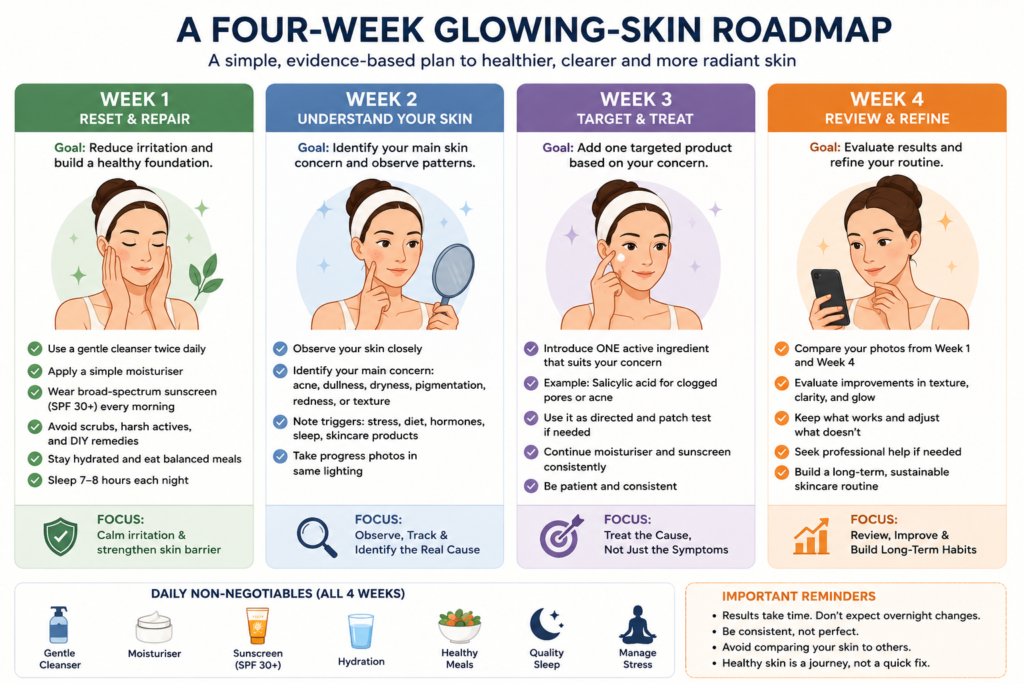
Week One: Reduce Irritation
Stop facial scrubs, harsh soaps, lemon juice, toothpaste remedies and unnecessary exfoliating products.
Use only:
- a gentle cleanser;
- a plain moisturiser;
- sunscreen during the day.
This creates a stable starting point.
Week Two: Identify the Main Concern
Look at the skin carefully.
Is the problem primarily:
- active acne;
- blackheads;
- dryness;
- tanning;
- dark marks;
- redness;
- itching;
- rough texture?
Do not label every issue as dullness.
Week Three: Add One Targeted Product
Choose one active ingredient suitable for the concern.
For example, someone with mild acne may consider a professionally recommended benzoyl peroxide product. NHS guidance notes that benzoyl peroxide usually takes several weeks to begin working, so overnight expectations are unrealistic.
Introduce one product at a time. Stop or reduce use if severe irritation appears.
Week Four: Review Progress
Take photographs in similar lighting and compare:
- number of active breakouts;
- dryness;
- redness;
- skin comfort;
- texture;
- new dark marks.
Do not rely only on how the skin looks in different mirrors or lighting conditions.
Mistakes That Can Make Skin Worse
Starting Several Products Together
Using a new syrup, serum, face wash and supplement on the same day makes it impossible to identify what helped or caused irritation.
Scrubbing Pimples
Scrubbing does not remove acne from beneath the skin. It can worsen inflammation and damage the protective barrier.
Assuming “Natural” Means Safe
Plant-based products can cause allergic reactions, digestive problems and medicine interactions.
In the United States, dietary supplements are regulated differently from medicines and are not approved by the FDA for safety and effectiveness before marketing. Regulations vary by country, so users should also check their national regulator.
Ignoring Added Sugar
Some syrups contain sweeteners to hide bitter flavours.
People managing blood sugar, dental concerns or calorie intake should check the nutrition and ingredient information.
Expecting Skin Lightening
Healthy or glowing skin does not mean lighter skin.
Be cautious of products claiming to change natural skin colour. The goal should be comfort, hydration, even texture and management of unwanted pigmentation—not unsafe bleaching.
Delaying Medical Treatment
Severe acne can leave permanent scars. A recurring rash may be caused by an allergy, infection or inflammatory condition.
A syrup should not be used to postpone appropriate care.
Myths and Facts
| Myth | Fact |
|---|---|
| Pimples prove the blood is dirty | Acne usually involves oil, blocked pores, bacteria and inflammation |
| Bitter syrups work better | Taste does not prove effectiveness |
| Herbal products have no side effects | Herbs can cause reactions and interactions |
| More ingredients create faster results | Large blends may increase uncertainty |
| Drinking excess water clears acne | Hydration helps normal function but does not treat every cause |
| Skin must worsen before improving | New irritation may mean the product is unsuitable |
| A syrup can replace sunscreen | Oral products do not block ultraviolet radiation |
| Glowing skin means fair skin | Healthy skin exists in every natural skin tone |
When to See a Dermatologist
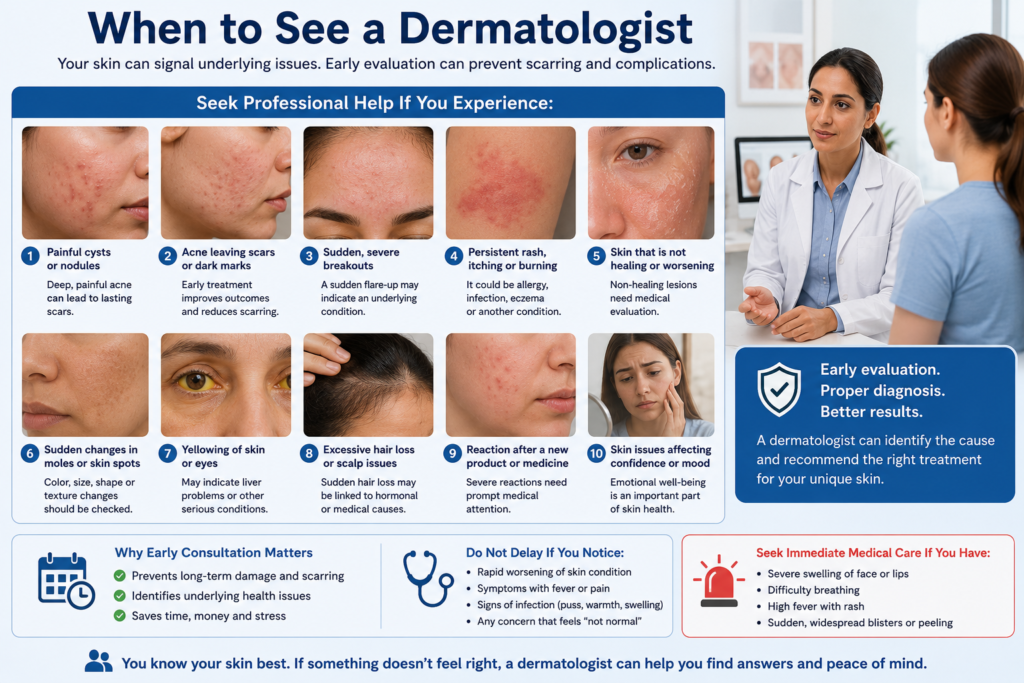
Seek professional advice when you have:
- painful cysts or nodules;
- acne that is leaving scars;
- sudden widespread breakouts;
- intense itching or burning;
- facial swelling;
- recurring adult acne with hormonal symptoms;
- yellowing of the skin or eyes;
- dark urine after starting a supplement;
- severe abdominal pain;
- a rash that spreads quickly;
- a skin problem affecting confidence or emotional wellbeing.
Severe acne may need prescription treatment. It cannot always be controlled with cosmetic products or herbal syrups.
Future of Oral Skin Products
The oral beauty market is moving toward more transparent formulations.
Consumers increasingly expect companies to disclose exact ingredient quantities, botanical identities, testing methods and possible interactions. Third-party testing for microbes, heavy metals and undisclosed ingredients may also become a stronger buying factor.
Research into the relationship between nutrition, the gut microbiome, inflammation and skin health will continue. However, early research should not be turned into guaranteed marketing claims.
The strongest future products will likely focus on specific, measurable needs rather than vague promises to cleanse the entire body.
Frequently Asked Questions
Does blood purifier syrup really work?
Results depend on the ingredients, dose, product quality and cause of the skin problem. There is no universal syrup proven to clear every type of acne or dullness.
Can a blood purifier remove pimples?
It may not address the biological causes of acne. Targeted acne treatment is usually more appropriate, especially for persistent or painful breakouts.
How long should I take a skin syrup?
There is no standard duration for all products. Follow the label and professional guidance. Stop and seek advice if you develop a rash, digestive symptoms or another reaction.
Can teenagers use blood purifier syrup?
Teenagers should use oral herbal products only after a parent or guardian checks the formulation with a doctor or pharmacist.
Can I take it with acne medicine?
Do not assume the combination is safe. Herbs, vitamins and minerals may interact with medicines. Share the complete ingredient list with a healthcare professional.
What is the safest way to improve skin glow?
Use gentle cleansing, moisturiser, broad-spectrum sunscreen, balanced meals and sufficient sleep. Treat acne, dryness and pigmentation according to their individual causes.
Conclusion to best blood purifier syrup for glowing skin
The best blood purifier syrup for glowing skin cannot be selected from advertising claims alone.
The idea that acne or dullness automatically comes from dirty blood is misleading. Most common skin concerns involve clogged pores, inflammation, dryness, ultraviolet exposure, irritation, hormones or lifestyle factors.
Begin with a simple routine. Cleanse gently, moisturise consistently and protect the skin with broad-spectrum sunscreen. Identify the exact concern before adding an active ingredient.
A herbal syrup may be considered as optional supportive care when the label is transparent, the claims are realistic and relevant risks have been reviewed. It should never replace medical treatment, a balanced diet or evidence-based skincare.
Healthy-looking skin usually improves through correct diagnosis and consistent care—not through the strongest detox promise.